
How to play Texas Hold'em: hands, odds and position
Updated 18 October 2026
Texas Hold'em takes a few minutes to learn and a lot longer to play well. This guide covers the rules, then the few ideas that make most of the difference: which hands to play, where you sit, and whether a call is worth its price. It uses Syphon's Texas Hold'em, where the chips are play chips and the regulars are happy to teach you the hard way.
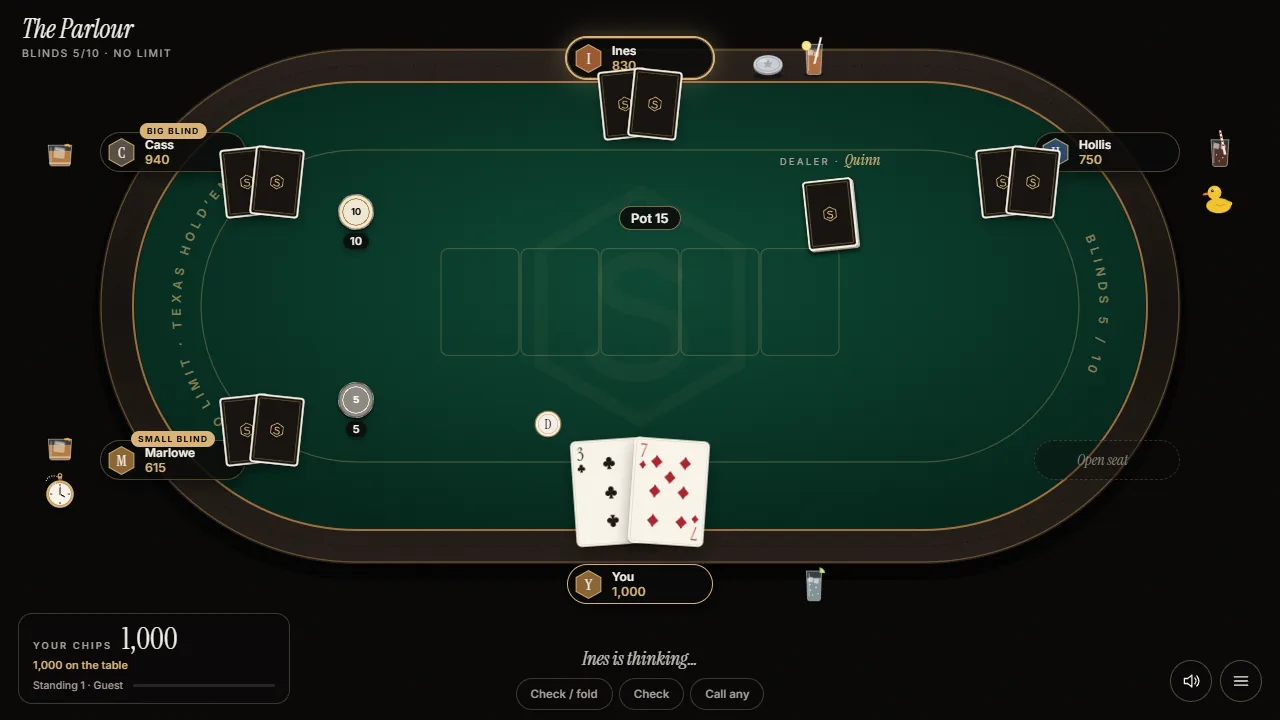
How a hand runs
Two players put in forced bets before the cards are dealt: the small blind and the big blind, in the two seats to the left of the dealer button, which moves one seat round after every hand. In the Brass Room and the Vault everybody also pays an ante, so every pot starts with something worth winning.
Everyone is dealt two cards face down, their hole cards, and there are four rounds of betting:
- Pre-flop, on the hole cards alone, starting with the player to the left of the big blind.
- The flop: three shared cards are dealt face up in the middle.
- The turn: a fourth shared card.
- The river: the fifth and last.
On your turn you can fold (give up the hand), check (pass, when nobody has bet), call (match the bet), or bet and raise. This is no-limit, so a bet can be anything from the minimum up to every chip in front of you, and a raise must be at least as big as the last bet or raise. If more than one player is left after the river, the hands are shown and the best five-card hand made from your two cards and the five on the board wins. Equal hands split the pot.
When a player is all in for less than the others are betting, the extra chips go into a side pot that only the players who matched them can win. If everyone left is all in before the river, the hands are turned face up and each one's chance of winning is shown on the table as the last cards come.
The hand rankings
From best to worst. Suits never rank above one another.
- Royal flush: ace, king, queen, jack and ten of one suit.
- Straight flush: five in a row, all one suit.
- Four of a kind: four cards of one rank.
- Full house: three of a kind and a pair.
- Flush: five of one suit, in any order.
- Straight: five in a row of mixed suits. An ace plays high (ten to ace) or low (ace to five).
- Three of a kind: three cards of one rank.
- Two pair: two pairs and one more card.
- One pair: two cards of one rank.
- High card: nothing else, so the highest card plays.
When two players have the same kind of hand, the higher cards win, down to the last of the five. A pair of nines with an ace beats a pair of nines with a king. That spare card is the kicker, and losing to one is a lesson most players learn the hard way.
Which hands to play
Most of the time the right move before the flop is to fold. Beginners lose most of their chips by playing too many hands, weak aces and unsuited low cards especially, and hoping the flop rescues them.
The game's hints (the book) judge starting hands with the Chen formula, a pen-and-paper score for two cards:
- Score your highest card: ace 10, king 8, queen 7, jack 6, and anything lower half its value, so a nine is 4.5.
- A pair doubles that score, and any pair is worth at least 5.
- Add 2 if the two cards are the same suit.
- Take off 1, 2, 4 or 5 for a gap of one, two, three, or four or more ranks between them.
- Add 1 if the cards are touching or one apart and both lower than a queen.
- Round up.
Pocket aces score 20, kings 16, queens 14 and jacks 12. Ace-king of one suit scores 12 and of mixed suits 10, king-queen suited 10, jack-ten suited 9, a pair of eights 8, and seven-six suited and ace-two suited 7. Seven-two of mixed suits, the worst hand there is, scores -1.
When nobody has raised yet, the book raises to three big blinds with 8 or more and just calls with a 7. When somebody has raised, it re-raises to three times their bet with 11 or more, calls with 9 or 10, and otherwise folds unless the price is tiny, two big blinds or less, and the hand wins often enough to justify it.
Position
The player on the button acts last on every round after the flop, so they see what everybody else did before deciding. That information is worth a lot. Play more hands near the button and fewer from the seats that act first. The book builds this in: from the button and the seat just before it, every hand counts one point higher, which turns a 7 into a raise.
Pot odds: is the call worth it?
Pot odds compare what a call costs with what it could win. If the pot holds 150 and someone bets 50, the pot is 200 and your call makes it 250. You are putting in 50 of the 250, so you need to win more than a fifth of the time, 20 per cent, for the call to pay over many hands.
To estimate your chance after the flop, count your outs: the cards still to come that would give you the winning hand. Four to a flush leaves nine outs. With two cards to come, multiply your outs by four; with one card to come, by two. Nine outs on the flop makes about 36 per cent, close to the true 35, and on the turn the rule gives 18 against a true 20.
Turn on odds and hints in Settings and the game does the sums for you. On your turn it shows a line like "You win about 34% against two hands · the call needs 20% · the book says call". The winning chance comes from playing out the rest of the board hundreds of times against hands it cannot see. After the flop the book follows the numbers. With no bet to face, it bets about two-thirds of the pot when its hand wins 62 per cent of the time or more, and otherwise checks. Facing a bet, it raises from 75 per cent, calls whenever its chance beats the price, and folds when it does not. Before the flop it goes by the starting-hand score instead, because the pot is still going to grow.
Reading the regulars
The empty seats at a single-player table fill with regulars, and each plays a recognisable style:
- The rock (Otto and Rook) plays few hands and almost never bluffs. When a rock bets big, believe it. When one folds, take the blinds.
- The calling station (Hollis and Dex) limps in with all sorts and calls far too often, but rarely bluffs. Do not bluff a station. Bet your good hands and let them pay you.
- The maniac (Vesper and Ines) raises a lot and bluffs often. Let them bet into you when you have a decent hand, and call them down lighter than you would anyone else.
- The trapper (Juniper, Lark and Cass) slow-plays big hands, checking and calling instead of raising. A trapper who has only called is not necessarily weak.
- The solid player (Marlowe, Sable and Mae) plays sensible, by-the-book poker.
How well they play depends on the room. The regulars in the Parlour are forgiving and make mistakes; in the Gallery they are capable, in the Brass Room good, and in the Vault dangerous.
The four rooms
- The Parlour: blinds 5 and 10, no ante, buy in for 200 to 1,000. Open from the start.
- The Gallery: blinds 25 and 50, no ante, buy in for 1,000 to 5,000. Opens at 4,000 chips.
- The Brass Room: blinds 100 and 200 with an ante of 20, buy in for 4,000 to 20,000. Opens at 15,000 chips.
- The Vault: blinds 500 and 1,000 with an ante of 100, buy in for 20,000 to 100,000. Opens at 75,000 chips.
You start with 1,000 play chips. When you sit down you take as much as the room allows, up to its maximum buy-in, and the rest waits in your pocket; between hands you can top up from it. A room stays open once you have reached it. Lose everything and the house extends a courtesy stake of 1,000 chips so you can carry on. Nothing here is real money, and nothing can be won.
Standing and achievements
Playing raises your standing from Guest to Legend, and the Lounge sells drinks, trinkets, card backs and felts for your seat. There are 25 achievements, from Pocket Rockets (be dealt a pair of aces) and Set Mining (flop three of a kind with a pocket pair) to Pure Bluff, Against the Odds (win an all-in as the underdog) and the Royal Flush, worth 10,000 chips.
Playing with friends
Choose Play with friends, open a table in the room you want and read out its four-letter code; friends type it in from the same menu. Up to six people can play. The SyphonGames server deals every card, so each player sees their own hole cards and nobody else's until the showdown, and regulars fill any empty seats. Everyone buys in for the room's maximum, and if you lose your stack you can buy back in.
Controls
On your turn, choose Fold, Check or Call, or set an amount with the slider or the Min, ½ pot, ¾ pot, Pot and All in buttons and press Bet or Raise. On a keyboard F folds, C checks or calls, R bets or raises, the arrow keys change the amount by one big blind, 1 to 5 pick the presets and A goes all in. While others are still deciding you can choose Check / fold, Check or Call any in advance. Esc opens the menu.
Ready to play?
Syphon's Texas Hold'em runs in your browser, free, with nothing to install. Play Syphon's Texas Hold'em now, or browse the categories for something else.
More guides
- Playing online with friends
- Keepsies: a guide to mibs, marbles and the eight Rings
- Little Bubbling: a guide to brewing, selling and staying out of the cells
- Syphon's Slap Arena: how to slap harder, defend and win the Slap League
- Chaos Island: how to survive every disaster
- Camp Kindling: a guide to your first nights
- Tall Tails: a fishing guide
- Contrail Cup: planes, stages and racing tips
- Pulsar League: a beginner's guide to rocket football
- Packfall: playing with your dog, and staying alive
- Acheron: a guide to your first escape
- Secret of Rapture: a spoiler-light guide
- Veyrfall: a tactics guide to the Broken Dominion
- Greenside: a golf guide to all nine holes
- Road Riot: a guide to fighting, racing and staying out of handcuffs
- Blackjack basic strategy: when to hit, stand, double or split
Spotted something out of date? Games here are updated often, so tell us through the contact page and we will fix the guide.