
Blackjack basic strategy: when to hit, stand, double or split
Updated 18 October 2026
Blackjack is the one casino game where the right decision on every hand is already known. This guide covers how Syphon's Blackjack plays, its four rooms and their rules, the full basic strategy its own hints use, and what insurance and the side bets really cost. Everything here is played with play chips, so it is a good place to learn the book before you trust it.
How a hand plays
Tap a chip to add it to your bet, then press Deal. You and the dealer each get two cards, and one of the dealer's is face down: the hole card. Number cards count their face value, jacks, queens and kings count ten, and an ace counts eleven unless that would take you over 21, when it counts one. A hand with an ace still counting eleven is called soft. Soft 17 is an ace and a six, and no single card can bust it.
A blackjack, an ace and a ten-value card as your first two cards, pays 3 to 2: a 100-chip bet wins 150. When the dealer's face-up card is an ace or worth ten, the dealer checks the hole card for blackjack before anyone plays. If it is there, the hand ends at once. You lose your bet unless you have blackjack too, which is a push, and you never lose chips you had not yet put down for a double or a split.
Then it is your turn:
- Hit: take another card. Go over 21 and you bust, losing at once, even if the dealer busts later.
- Stand: keep what you have.
- Double: double your bet on your first two cards and take exactly one more card.
- Split: two cards of the same value become two hands, each with a bet the size of the first. You can split up to four hands and double after splitting at every table. Split aces get one card each. Any two ten-value cards count as a pair, so a jack and a king can be split, though the book never does it.
- Surrender: in the rooms that allow it, give up your first two cards and get half your bet back. It is only offered before you have split.
Once everybody has played, the dealer turns over the hole card and draws until reaching 17 or more. In every room except the Brass Room the dealer stands on a soft 17; in the Brass Room the dealer hits it. A win pays even money and a tie, a push, returns your bet.
The four rooms
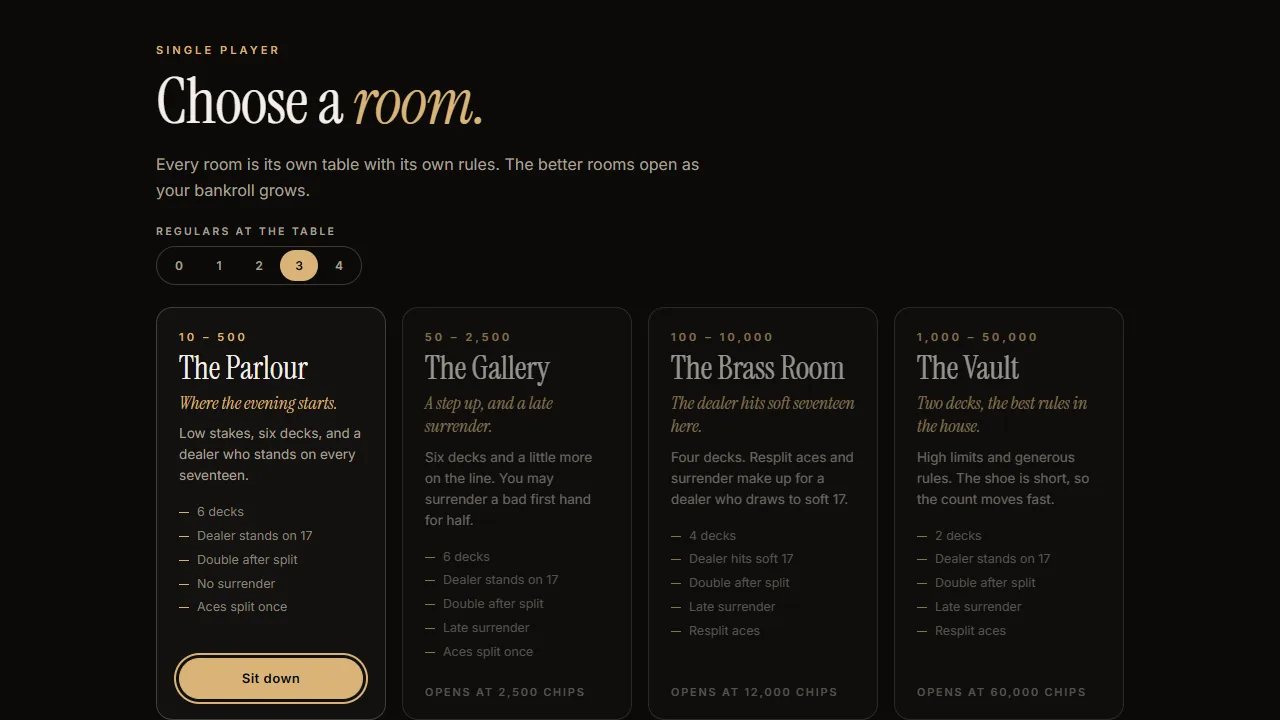
You start with 1,000 play chips in the Parlour. The other rooms open the first time you hold enough chips, and stay open after that.
- The Parlour: bets 10 to 500, side bets up to 100. Six decks, the dealer stands on soft 17, double after split, no surrender, aces split once. Open from the start.
- The Gallery: bets 50 to 2,500, side bets up to 500. Six decks, the dealer stands on soft 17, double after split, late surrender. Opens at 2,500 chips.
- The Brass Room: bets 100 to 10,000, side bets up to 2,000. Four decks, the dealer hits soft 17, double after split, late surrender, aces can be split again. Opens at 12,000 chips.
- The Vault: bets 1,000 to 50,000, side bets up to 10,000. Two decks, the dealer stands on soft 17, double after split, late surrender, aces can be split again. Opens at 60,000 chips.
The Vault has the best rules in the house. Fewer decks help the player slightly, and so do surrender and resplitting aces. A dealer who hits soft 17 wins a little more often, which is what the Brass Room's extra rules make up for. The shoe is shuffled once roughly two-thirds to three-quarters of it has been dealt.
Basic strategy: the book
For every combination of your hand and the dealer's face-up card there is one decision that loses the least over time. Together they are called basic strategy, and Syphon's Blackjack calls it the book. Turn on strategy hints in Settings and the book's move is marked every time it is your turn, which is the quickest way to learn it.
The rules below are the book the game uses: the standard chart for four to eight decks with doubling after a split. "Against 2 to 6" means the dealer's face-up card, and an ace counts as the highest card. They apply in every room, with the Brass Room's changes listed at the end. In the two-deck Vault a perfect two-deck chart differs on a few borderline hands, by very small amounts.
Hard totals (no ace counting eleven)
- 17 or more: always stand.
- 13 to 16: stand against 2 to 6, hit against 7 to ace.
- 12: stand against 4 to 6, otherwise hit.
- 11: double against 2 to 10. Against an ace, hit.
- 10: double against 2 to 9, hit against a ten or an ace.
- 9: double against 3 to 6, otherwise hit.
- 8 or less: always hit.
When the book says double but you cannot, because you already have three cards, hit instead.
Soft totals (an ace counting eleven)
- Soft 19 to 21 (ace-eight and up): stand.
- Soft 18 (ace-seven): double against 3 to 6, stand against 2, 7 and 8, and hit against 9, ten and ace.
- Soft 17 (ace-six): double against 3 to 6, otherwise hit.
- Soft 15 and 16 (ace-four, ace-five): double against 4 to 6, otherwise hit.
- Soft 13 and 14 (ace-two, ace-three): double against 5 and 6, otherwise hit.
A soft hand of three or more cards cannot double. Hit wherever the book says double, except on soft 18, which stands. Hitting a soft 18 against a 9, a ten or an ace surprises people, but the hand cannot bust on the next card, and a standing 18 loses more than it wins against those dealer cards.
Pairs
- Aces and eights: always split.
- Tens: never split. Twenty is too good to break up.
- Nines: split against 2 to 6, 8 and 9. Stand against 7, ten and ace.
- Sevens: split against 2 to 7, otherwise hit.
- Sixes: split against 2 to 6, otherwise hit.
- Fives: never split. Play them as a hard 10.
- Fours: split against 5 and 6, otherwise hit.
- Twos and threes: split against 2 to 7, otherwise hit.
Surrender
In the Gallery, the Brass Room and the Vault you may give up your first two cards for half your bet. The book does it rarely:
- Hard 16 against 9, ten or ace. A pair of eights is split instead.
- Hard 15 against a ten.
What changes in the Brass Room
Because the dealer hits soft 17 there, the book changes in six places:
- Double 11 against an ace.
- Double soft 19 against a 6.
- Double soft 18 against a 2 as well.
- Surrender hard 15 against an ace.
- Surrender hard 17 against an ace.
- Surrender a pair of eights against an ace instead of splitting them.
Soft 19 is the one other hand that stands when it cannot double.
Insurance and even money
When the dealer shows an ace you are offered insurance: a side bet of half your stake that pays 2 to 1 if the hole card makes blackjack. If you hold blackjack yourself, the same bet is called even money, and taking it pays your bet one to one straight away.
The book never takes either. Insurance only breaks even if the hole card is a ten more than a third of the time, and in a six-deck shoe it is a ten about 31 times in 100. Over many hands it costs you, which is exactly why the cautious regulars buy it.
The side bets
Before the deal you can put chips on two side bets, up to the room's side-bet limit, by tapping the small circles on the felt. Both are settled as soon as the cards are out, whatever happens to the hand itself.
- Perfect Pairs wins if your first two cards are a pair. A mixed pair (one red, one black) pays 6 to 1, a coloured pair (same colour, different suits) 12 to 1, and a perfect pair (same suit) 25 to 1.
- 21+3 makes a three-card poker hand from your two cards and the dealer's face-up card. A flush pays 5 to 1, a straight 10 to 1, three of a kind 30 to 1, a straight flush 40 to 1 and suited trips 100 to 1. Aces count high or low, so ace-two-three and queen-king-ace are straights, but king-ace-two is not.
They are fun, and two achievements need them, but they are the most expensive bets on the table. With these pay tables the house keeps around 3 to 4 chips of every 100 bet on them, against less than half a chip on a main hand played by the book.
The regulars
Up to four regulars can share your table; choose how many on the room screen. Each has a recognisable style:
- Marlowe, Sable and Mae play the book perfectly.
- Vesper and Ines are bold. They never surrender, double every 9, 10 and 11 they can, and split tens against a 5 or a 6.
- Otto and Rook are cautious. They never risk busting, standing on any hard 12 or more, and they buy insurance on good hands.
- Juniper, Lark and Cass follow the book until a hunch takes them, which happens now and then.
- Hollis and Dex copy the dealer, hitting anything under 17.
A common worry at real tables is that a bad player "takes the dealer's bust card". It feels true, but it is not: other players' choices change which cards you happen to get, never your chances. Over many hands a table full of Hollises costs you nothing.
Looking after your chips
Nothing here is real money and nothing can be won, but a bankroll still lasts longer handled well:
- Bet small against your total. One or two per cent a hand, 10 or 20 chips from your first 1,000, rides out the losing runs that come to everybody.
- Move up a room when its minimum is a small slice of what you hold, not as soon as the door opens. The Gallery opens at 2,500 chips, which is only fifty of its minimum bets.
- Every 25 hands at a single-player table the house sends complimentary chips, and each new standing pays a bonus.
- Run out completely and the house extends a courtesy stake of 1,000 chips, so you are never locked out.
Standing, the Lounge and achievements
Every hand earns experience, more for a win and most for a blackjack, and experience raises your standing from Guest through Regular, Member, Patron, Insider, High Roller, Connoisseur and Maestro to Legend. The Lounge sells drinks, trinkets, card backs and felts for your seat with your chips, and some of them need a certain standing or an achievement first. There are 21 achievements, from Natural (be dealt a blackjack) and Two Birds (win every hand of a split) to Lucky Sevens (21 with three sevens) and Into the Vault.
Playing with friends
Choose Play with friends, open a table, pick the room and how many regulars to seat, and read out the four-letter code. Friends type it in from the same menu. Up to five people can sit at a table, regulars fill the empty seats and stand up for anyone who arrives, and if you run out of table chips you can buy back in. Online tables are dealt by the SyphonGames server, so everybody plays from the same shoe.
Controls
Tap a chip to add it to your bet (1 to 4 pick a chip), tap the small PP and 21+3 circles for side bets, and press Deal. Space deals, or repeats your last bet. During a hand H hits, S stands, D doubles, P splits and R surrenders, the same as the buttons along the bottom. Esc opens the menu.
Ready to play?
Syphon's Blackjack runs in your browser, free, with nothing to install. Play Syphon's Blackjack now, or browse the categories for something else.
More guides
- Playing online with friends
- Keepsies: a guide to mibs, marbles and the eight Rings
- Little Bubbling: a guide to brewing, selling and staying out of the cells
- Syphon's Slap Arena: how to slap harder, defend and win the Slap League
- Chaos Island: how to survive every disaster
- Camp Kindling: a guide to your first nights
- Tall Tails: a fishing guide
- Contrail Cup: planes, stages and racing tips
- Pulsar League: a beginner's guide to rocket football
- Packfall: playing with your dog, and staying alive
- Acheron: a guide to your first escape
- Secret of Rapture: a spoiler-light guide
- Veyrfall: a tactics guide to the Broken Dominion
- Greenside: a golf guide to all nine holes
- Road Riot: a guide to fighting, racing and staying out of handcuffs
- How to play Texas Hold'em: hands, odds and position
Spotted something out of date? Games here are updated often, so tell us through the contact page and we will fix the guide.