
Greenside: a golf guide to all nine holes
Updated 16 October 2026
Greenside is golf with three decisions per shot: the club, the line and the swing. This guide explains exactly how each one works, from how far every club flies to what the swing meter is really asking of you, then walks through all nine holes.
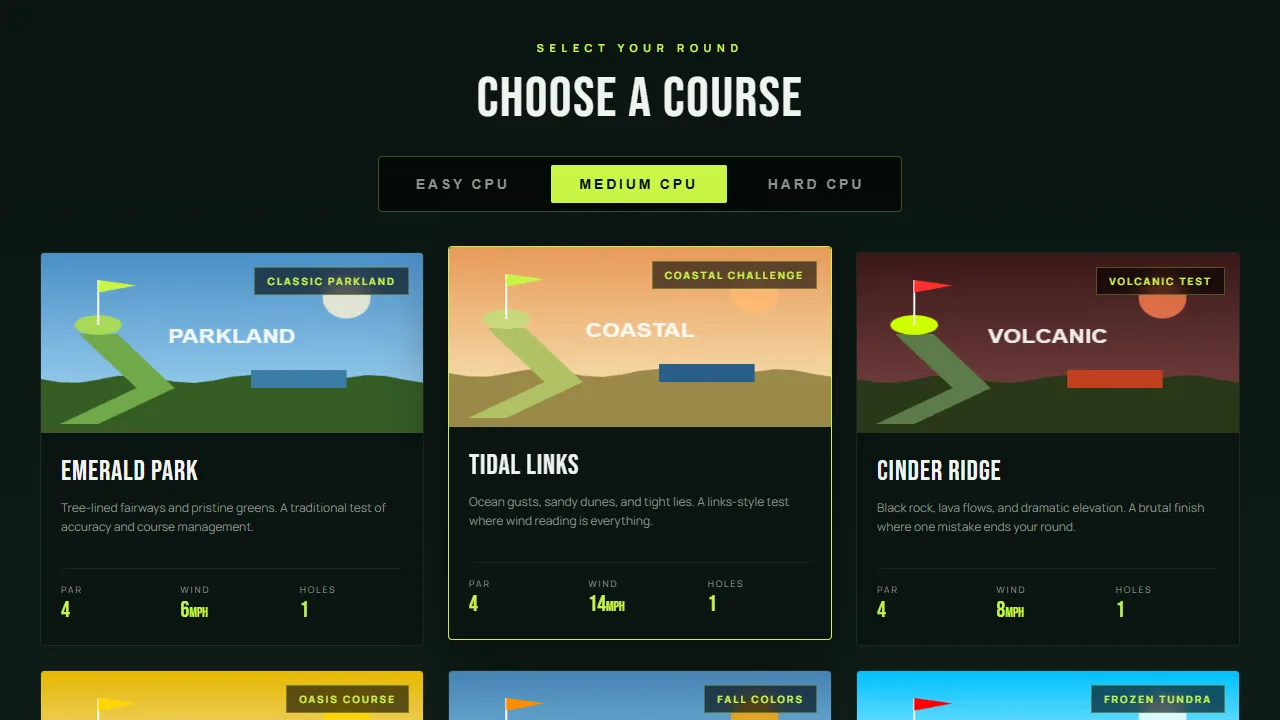
How a round works
Greenside has nine holes, each a par 4 of roughly 460 to 490 yards with its own scenery, hazards and wind. From the course select screen you can play a single hole, several, or all nine. On your own you play against a CPU golfer, taking turns shot by shot; with Play a Friend one of you shares a four-letter code and you play the same holes against each other, with the server keeping the scorecard. Every hole is scored against par, from a hole in one, eagle and birdie down to bogey, double bogey and worse.
The eight clubs
Each club has a maximum carry, and your power on the swing meter decides how much of it you get: half power on a club means half its distance. The clubs also differ in how the ball behaves when it lands, which matters as much as how far they go.
- Driver: up to 280 yards, low launch, and the ball runs a long way after landing.
- 3-wood: up to 230 yards, still plenty of roll.
- 5-iron: up to 180 yards.
- 7-iron: up to 150 yards.
- 9-iron: up to 120 yards, higher and softer.
- Pitch: up to 90 yards, and the ball barely rolls.
- Sand: up to 50 yards, the highest launch and almost no roll.
- Putter: up to 30 yards along the ground.
Change club with 1 to 8. The usual pattern on a 480-yard hole is a driver, then a mid or short iron. For the approach, prefer the higher clubs: a pitch or sand shot stops close to where it lands, while a long iron landing on the green can roll straight off the back of it.
The swing meter
Aim with A and D, then press Space to start the swing. The meter rises: press Space again to set your power. The marker then falls back, and the third press sets accuracy. The green band at the bottom, marked SNAP, is the target:
- Perfect: you stopped it inside the band. The ball flies straight down your aim line.
- Good: just past the band. A slight curve, rarely a problem.
- Hook: further out. The ball bends noticeably off line.
- Shank: well past it. Expect trouble.
Power and accuracy are separate presses, so a full-power shot is no harder to hit straight than a gentle one. Choose the club that covers the distance and concentrate on the timing of the third press.
Bending the ball in the air
Once the ball is flying, hold A or D to curve it left or right. This is how you rescue a hook, and how you shape a shot around trees or a bunker that sits on the straight line to the flag. The longer you hold, the more it bends, so small touches are usually enough.
Wind
The wind arrow and its speed in mph sit on screen, and the wind pushes the ball for the whole of its flight. High shots are in the air longest, so they move the most. Aim into a crosswind and let it bring the ball back, take an extra club into a headwind, and expect a tailwind to carry you further and run you out further too. The windiest holes are Tidal Links and Arctic Frost.
Where the ball ends up
- Fairway and green let the ball run. The green is the fastest surface of all, and slopes on it push a rolling ball sideways.
- Rough halves the ball's speed when it lands, and it rolls much less afterwards.
- Sand stops a landing ball almost dead and grabs anything rolling into it, so a ball that finds a bunker stays there.
- Water costs a one-stroke penalty. On Cinder Ridge the "water" is lava, with the same penalty.
- Out of bounds, far beyond the edges of the hole, also costs one stroke.
Your lie does not weaken your next swing, so a ball in the rough is not a disaster in itself; the cost is the roll you lost getting there.
Putting
The putter sends the ball along the ground up to 30 yards at full power, so a ten-yard putt needs only about a third of the meter. The accuracy press still matters: a putt that is not hit straight curls away, and the slope of the green adds its own break. From the rough beside the green, a chip with the pitch or sand club is often easier to judge than a putt, which the rough slows down.
The nine holes
Emerald Park
Classic parkland: tree-lined fairways, three bunkers and a pond, in a light breeze of around 6 mph. The gentlest place to learn the swing.
Tidal Links
A coastal links with seven bunkers in the dunes, the sea along the hole and the strongest wind on the course, around 14 mph. Wind reading is everything here.
Cinder Ridge
Black rock and two lava flows that count as water hazards, plus three bunkers and dramatic elevation. One mistake can cost you the hole.
Desert Mirage
Endless sand and two oasis pools that are easy to underestimate, in a wind of around 10 mph.
Autumn Valley
The shortest hole, at about 460 yards, but the fairway is tight and framed by trees. Accuracy beats distance.
Arctic Frost
Snow-covered fairways where the ball runs a long way on the frost, icy water, and a wind of around 12 mph. Take less club than you think.
Night Owl
A neon night course with glowing greens and the lightest wind, around 5 mph. At about 490 yards it is also the longest hole.
Cherry Blossom
A pretty spring hole lined with blossom trees whose hazards are tighter than they look.
Golden Hour
A savanna at sunset with long shadows, dry grass and a wind of around 9 mph.
Controls at a glance
A and D aim, 1 to 8 choose a club, Space three times swings (start, power, accuracy), and A or D in flight curves the ball. On a phone, tap and drag to aim and tap the meter to swing.
Ready to play?
Greenside runs in your browser, free, with nothing to install. Play Greenside now, or browse the categories for something else.
More guides
- Playing online with friends
- Keepsies: a guide to mibs, marbles and the eight Rings
- Little Bubbling: a guide to brewing, selling and staying out of the cells
- Syphon's Slap Arena: how to slap harder, defend and win the Slap League
- Chaos Island: how to survive every disaster
- Camp Kindling: a guide to your first nights
- Tall Tails: a fishing guide
- Contrail Cup: planes, stages and racing tips
- Pulsar League: a beginner's guide to rocket football
- Packfall: playing with your dog, and staying alive
- Acheron: a guide to your first escape
- Secret of Rapture: a spoiler-light guide
- Veyrfall: a tactics guide to the Broken Dominion
- Road Riot: a guide to fighting, racing and staying out of handcuffs
- Blackjack basic strategy: when to hit, stand, double or split
- How to play Texas Hold'em: hands, odds and position
Spotted something out of date? Games here are updated often, so tell us through the contact page and we will fix the guide.