
8 ball pool rules: fouls, ball in hand and how to win
Updated 25 October 2026
Eight-ball is the most played pool game in the world, and its rules are simpler than they look: claim a group, clear it, then sink the black. This guide explains the rules exactly as 8 Ball Billiards enforces them, where they differ from the pub rules you may know, and the aiming and positional habits that turn a run of two balls into a run of seven.
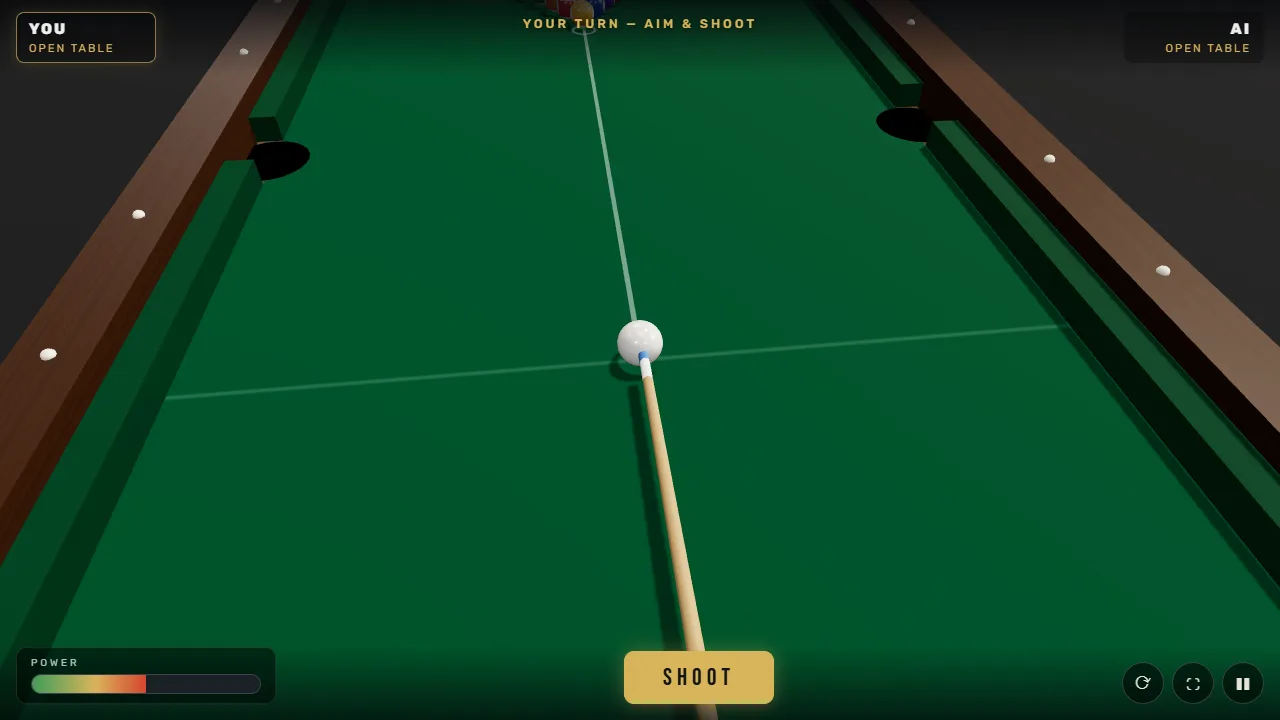
The table and the rack
The playing surface is 2.24 metres by 1.12 metres, the two-to-one shape of a full-size table, with six pockets. The four corner pockets are a touch more generous than the two middle ones. There are fifteen object balls: the solids, numbered 1 to 7, the stripes, 9 to 15, and the black 8-ball.
The balls are racked in a triangle with the 1-ball at the front on the foot spot, the 8-ball in the middle of the third row, and a solid and a stripe in the two back corners. The cue ball starts on the head spot at the other end for the break.
The break
Against the computer you always break. Online, the player who opened the table breaks. Nobody owns a group yet: the table is open.
- If a ball drops and the shot is not a foul, you shoot again, and the first ball that dropped decides your group (see below).
- If nothing drops, the turn passes.
- If the 8-ball drops on the break, you do not lose. It is put back on the foot spot, or as near behind it as there is room, and play carries on.
- If the cue ball drops, it is a scratch: a foul, and your opponent gets ball in hand.
The strongest break here is a full-power shot (push the power meter to the top) straight into the front of the 1-ball. A dead-centre hit hands nearly all of the cue ball's speed to the rack, so the cue ball stops close to the middle of the table, well away from the pockets, and the rack spreads hard.
Solids, stripes and the open table
While the table is open you may hit any ball first, even the 8-ball, without fouling. The first ball you pot legally decides your group: pot a solid and solids are yours for the rest of the frame, and your opponent takes stripes. If balls from both groups drop on the same shot, the one that dropped first decides it. A pot on a foul shot, such as a scratch, assigns nothing, and the table stays open.
Be careful with the 8-ball on an open table. Hitting it is allowed, but potting it at any time other than the break loses the frame on the spot.
When you keep shooting
Pot at least one ball of your own on a shot that is not a foul and you shoot again. Pot nothing, or foul, and the turn passes. Potted balls stay down for the rest of the frame; only the 8-ball on the break is ever put back.
Fouls
A foul ends your turn, even if you potted one of your own balls on the same shot. There are four:
- No ball hit. The cue ball touched nothing.
- Wrong ball first. Once groups are decided, the first ball the cue ball touches must be one of yours, or the 8-ball once your group is cleared. Hitting your opponent's ball first is a foul, and so is hitting the 8-ball first while you still have balls of your own on the table.
- Scratch. The cue ball drops into a pocket.
- Potting your opponent's ball. This is stricter than most pub rules: it is a foul even if you hit your own ball first and potted one of your own too. A combination that might take one of theirs down with yours is a risk here, not a bonus.
Two rules you may know from elsewhere are not used. You do not have to call your shots, and nothing has to reach a cushion after contact, so rolling the cue ball softly up to one of your own balls is a perfectly legal shot. That is the basis of safety play.
Ball in hand
After a scratch your opponent gets ball in hand: they may place the cue ball anywhere on the table, not just behind the line at the break end, as long as it is clear of the pockets and the other balls. A ghost ball shows where it will go and turns red where it is not allowed. After any other foul your opponent simply plays from wherever the cue ball came to rest.
Ball in hand is the biggest advantage in the game. Place the cue ball for an easy pot that also leaves a good angle on your next ball, not just for the easiest pot on the table.
The 8-ball
When the last ball of your group drops, a banner says you are on the 8-ball. From then on the 8 is your target: hit it first and pot it to win the frame. Any pocket will do; there is no pocket to call.
You lose the frame at once if you:
- pot the 8-ball before your group is cleared (except on the break), or
- scratch on the shot that pots the 8-ball.
So on the final shot, think about where the cue ball goes as much as the 8. A straight, full pot into a corner stops the cue ball dead, which is the safest way to finish.
Aiming
When it is your turn the table shows a line from the cue ball to the first ball it will meet, a ring where the cue ball will be at the moment of contact, and a short line showing which way the object ball will go. Point that short line at the middle of the pocket and the pot is on.
The ring is what players call the ghost ball. Picture a second ball touching the object ball on the exact opposite side from the pocket, and send the centre of the cue ball to where that ghost sits. The game draws the ghost for you, which makes it a good place to learn the method you would use on a real table, where nobody draws it.
- Move or drag on the table to aim, then fine-tune with the Left and Right arrow keys. Each press turns the aim about one degree; hold Shift for steps of about a quarter of a degree.
- The thinner the cut, the more an error of a fraction of a degree is magnified, and the less speed the object ball takes away. A cut close to ninety degrees needs real power just to reach the pocket.
- Prefer the corner pockets when the pot is difficult. The middle pockets are slightly tighter.
Power
The power meter runs from a soft tap to a firm full stroke, set by dragging the bar or with the Up and Down arrows in steps of five per cent. The cloth slows every ball steadily, but not by much: a ball rolling at a moderate pace will travel more than a whole table length before it stops. Most pots need far less power than it feels like they do.
Use power to decide where the cue ball finishes, not to force the pot in. A soft pot leaves the cue ball near the spot of contact; a firm one sends it a long way along its new path, possibly into a pocket.
Position play without spin
There is no top, draw or side spin in 8 Ball Billiards. Every shot behaves like what players call a stun shot, and that makes the cue ball's path after contact completely predictable once you know two rules:
- Full-ball hit: the cue ball stops. Hit the object ball dead centre and the cue ball keeps almost none of its speed. It stays very close to where the object ball was.
- Cut shot: the cue ball leaves at a right angle. On any cut, the object ball travels along the line between the two balls' centres at contact, and the cue ball goes off along the tangent line, at ninety degrees to it. The thinner the cut, the more of its speed the cue ball keeps.
So before every shot, look along the tangent line from the contact point. That is where the cue ball is going. If it points at a pocket, slow the shot down or choose another ball; if it points at your next ball's neighbourhood, you have position. Choosing which side of an object ball to come from is how you steer.
Cushions keep most of a ball's speed along the rail but absorb a quarter of the speed going into it, so a ball comes off a cushion at a flatter angle than it went in. Bank shots therefore run long. When you aim at a cushion the game draws the bounce as a perfect mirror; the real ball will come off a little flatter than that line, so aim at a point on the cushion slightly closer to you.
Safety play
When there is no pot you trust, do not shoot at one anyway. Roll the cue ball softly into one of your own balls so that it finishes behind a ball, or tight against a cushion, where your opponent has no clean line at theirs. It is legal, it costs you nothing, and against the computer it is especially strong.
Beating the computer
Choose the computer's level under Settings: Easy, Medium or Hard. On every turn it looks at each of its balls and each pocket, rules out pots whose path is blocked or whose cut is too thin, and plays the one with the best mix of a full angle and short distances. Then it adds a random error to its aim and power: roughly six degrees of aim on Easy, two and a half on Medium and under one on Hard, with power errors of up to 30, 15 and 6 per cent.
Two things follow. On Hard it will rarely miss a pot it chooses to play, so you win by leaving it nothing to choose. And when it has no open pot it plays a medium-paced hit at a random ball of its own, which often leaves you a chance. Tie its balls up behind yours, leave the cue ball against a cushion, and break up clusters while you are in control of the table.
After each frame the game shows how many shots you took, how many balls you potted and how many fouls you made.
Playing a friend online
Choose Play a Friend, open a table and read out the four-letter code; your friend types it in from the same menu. The player who opened the table breaks. Each shot is worked out on the shooter's own machine, and the SyphonGames server checks that the result is a sensible follow-on from the table before, keeps track of whose turn it is and records the winner, so neither player can take a shot out of turn.
Controls
Move or drag on the table to aim, with Left and Right for fine adjustment (hold Shift for smaller steps). Set power by dragging the power bar or with Up and Down, then press SHOOT or Space. The camera stays on the cue ball: right-drag, or drag with two fingers, to swing around it, use the mouse wheel to zoom, and press R to snap back behind the ball. With ball in hand, click or tap where the cue ball should go. Esc pauses. Settings has camera sensitivity, graphics quality, the computer's level and sound.
Ready to play?
8 Ball Billiards runs in your browser, free, with nothing to install. Play 8 Ball Billiards now, or browse the categories for something else.
More guides
- Playing online with friends
- Keepsies: a guide to mibs, marbles and the eight Rings
- Little Bubbling: a guide to brewing, selling and staying out of the cells
- Syphon's Slap Arena: how to slap harder, defend and win the Slap League
- Chaos Island: how to survive every disaster
- Camp Kindling: a guide to your first nights
- Tall Tails: a fishing guide
- Contrail Cup: planes, stages and racing tips
- Pulsar League: a beginner's guide to rocket football
- Packfall: playing with your dog, and staying alive
- Acheron: a guide to your first escape
- Secret of Rapture: a spoiler-light guide
- Veyrfall: a tactics guide to the Broken Dominion
- Greenside: a golf guide to all nine holes
- Road Riot: a guide to fighting, racing and staying out of handcuffs
- Lockdown: Undead strategy: how to survive more rounds
- Survillian guide: how to survive, level up and prestige
- Tilt guide: three stars, every world and the level editor
- Neon Rush tips: how to run further and score higher
- Lineflow guide: how to build tracks that flow
- Blackjack basic strategy: when to hit, stand, double or split
- How to play Texas Hold'em: hands, odds and position
- Air hockey rules and tips: how to score and defend
- Bowling scoring explained: strikes, spares and the 10th frame
Spotted something out of date? Games here are updated often, so tell us through the contact page and we will fix the guide.