
Bowling scoring explained: strikes, spares and the 10th frame
Updated 25 October 2026
Bowling scoring looks like arithmetic designed to confuse, but it rests on two rules: a strike borrows your next two balls and a spare borrows your next one. This guide explains the scoring with worked examples, then how Syphon's Ten Pin turns stance, angle, spin and power into a ball that curves into the pocket, how to pick up spares, and how each arcade challenge is scored.
How a game is scored
A game is ten frames. In each frame you have up to two balls to knock down all ten pins.
- Open frame: pins still standing after two balls. The frame scores the pins you knocked down. Seven and then two is an open frame worth 9.
- Spare, written /: all ten down with the two balls. The frame scores 10 plus the pins from your next ball.
- Strike, written X: all ten down with the first ball. The frame is over at once and scores 10 plus the pins from your next two balls.
Because strikes and spares wait for balls you have not bowled yet, the scorecard leaves their totals blank until those balls are in. That is all the mystery there is.
Worked examples
- A strike, then 7 and 2. The strike scores 10 + 7 + 2 = 19. The next frame is an open 9. Running total: 28.
- A spare, then a first ball of 8. The spare scores 10 + 8 = 18, whatever happens with your second ball.
- Three strikes in a row, called a turkey. The first of them scores 10 + 10 + 10 = 30.
- Every frame a spare with five on the first ball, plus a five on the bonus ball: each frame is worth 15, so the game is 150.
- Nine pins every frame and never a spare: 90. Spares are where the points are, long before strikes are.
The tenth frame
The tenth frame is the only one that can have three balls. Strike with your first ball and you get two more; make a spare and you get one more; leave an open frame and the game ends there. Those extra balls are only there to complete the bonus. A perfect game is twelve strikes in a row, ten frames plus the two bonus balls, and scores 300.
The lane
The lane is laid out to regulation: 60 feet from the foul line to the head pin, with the pins 12 inches apart in their triangle. The front of the lane is oiled, and a spinning ball barely curves there. From about 34 feet out the boards start to dry, and by about 43 feet the ball has full grip. That dry back end is where all the hook happens.
The gutters sit below the lane surface on both sides, and a ball that drifts over the edge drops in and rolls harmlessly to the pit. Turn on Bumpers in the Match setup and copper rails rise over both gutters, so no ball is ever lost; they apply to the arcade challenges too, except 100 Pin, which has no gutters at all.
Setting up a throw
A throw has four parts:
- Stance: where you stand across the approach. A and D, the aim slider, or drag on the lane on a touchscreen.
- Angle: up to four degrees either side of straight. The Left and Right arrows or the mouse wheel.
- Spin: from minus 10 to plus 10, which sets how hard and which way the ball hooks. W and S, or the spin slider.
- Power: hold the BOWL button or Space. The meter sweeps up and back down while you hold it, and the ball is thrown when you let go. Clicking the lane never throws, so you cannot bowl by accident.
A dashed guide line on the lane shows where the ball will go with your current stance, angle and spin, hook included. While you charge, it updates for the power you are holding.
Power and hook
Power sets the ball's speed, from a gentle roll at the bottom of the meter to nearly twice as fast at the top. Speed and hook work against each other. A slow ball spends longer crossing the dry back end, so it has more time to curve and swings hard. A fast ball crosses it quickly and holds a straighter line. There is no single right power: pick one you can repeat, then set stance and spin for it.
Throwing strikes: the pocket
Strikes come from the pocket, the gap between the head pin and the pin beside it, hit by a ball arriving at an angle. A ball that curves in carries pins across the rack as it goes, and the pins knock each other down. A ball that hits the head pin square, dead straight, tends to send pins out to the sides and leave the corners standing.
- Pick a power you can repeat, roughly the middle of the meter.
- Add a moderate amount of spin and watch the guide line bend on the back end.
- Move your stance towards the side the ball curves away from, so that the curve finishes in the pocket rather than past it.
- Adjust one thing at a time. If the ball comes in too far across the head pin, move your stance or reduce the spin; if it never reaches the pocket, add spin or bowl a little slower.
Picking up spares
- Pins standing close together: aim at the middle of the group.
- Pins spread out: aim at the one nearest the middle of the lane and let it take the others.
- A single corner pin (the 7 or the 10): bowl from the opposite side of the approach, across the lane, with little or no spin. A straight ball is more accurate than a hooking one when the target is one pin wide.
- Splits, where pins are left with a gap between them, need the ball to clip one pin across into the other. Some are makeable; the 7-10 is famous for being nearly impossible.
The computer bowler picks up spares in exactly this way, so watching where it aims is a free lesson.
The six balls
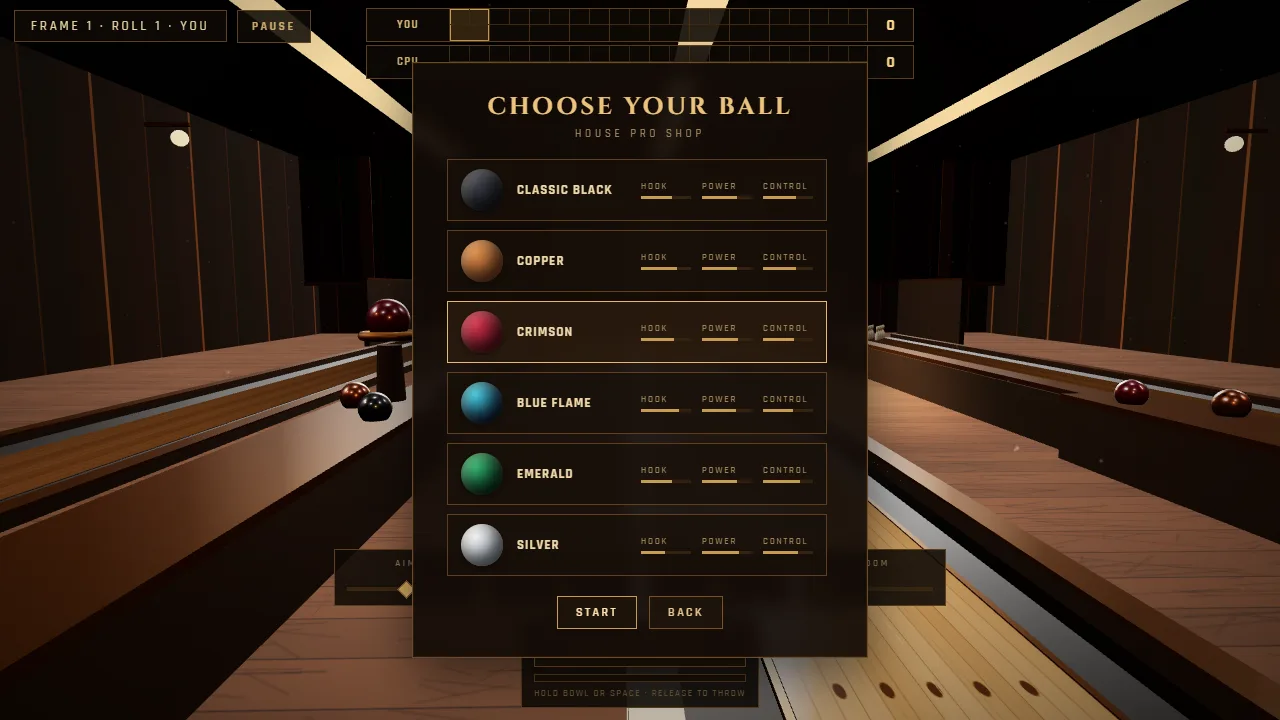
Choose a ball before each game; all six are free. Each has three ratings: hook, speed and control. Control slows the power meter's sweep, which makes it easier to let go at the power you want.
- Classic Black: the all-rounder everything else is measured against.
- Copper: about 15 per cent more hook, otherwise the same.
- Crimson: a little more hook and a touch more speed, with slightly less control.
- Blue Flame: the most hook in the shop, but the slowest ball and the hardest to control.
- Emerald: the most control, so the easiest meter to time.
- Silver: much less hook, the fastest ball, and good control. The ball for straight spare shooting.
Match mode and the computer bowler
A Match is ten frames against a computer bowler, with full scoring and the tenth frame's bonus balls. The difficulty changes how well it bowls, not how the lane plays:
- Easy sprays its line, throws a channel ball about one time in ten, hooks gently and occasionally curves the ball the wrong way.
- Normal is steadier, with a bad throw about one time in thirty.
- Hard is tight on line and pace, hooks hardest and almost never misses its mark.
The arcade challenges
Each challenge keeps your best score.
- 100 Pin: three throws at a ten-by-ten wall of a hundred pins on a widened lane with no gutters. One point per pin, so 300 is the ceiling. Power matters more than finesse here.
- Perfect Game: a full rack every throw, 30 points for each strike in a row. The first ball that is not a strike ends the run.
- Pin Rush: 75 seconds of waves. The first wave has four pins in random spots, each wave adds one more up to twelve, and every pin is a point. The clock runs while you aim, so do not linger.
- Target: five throws, each at three gold pins hidden among five ordinary ones. Gold pins pay 100 and the others 25, and taking all three gold pins with one ball adds a 200 bonus.
- Split Master: five famous splits in turn: the 7-10, the 4-6, the 2-7 baby split, the 3-10 and the 5-7. Converting one pays 500; leaving a pin pays 50 for each pin you did knock down.
Playing a friend
Choose Play a Friend, create a lane and read out the four-letter code; your friend types it in from the same menu, with no sign-up. You alternate frames, and both scorecards are kept by the SyphonGames server, so neither of you has to trust the other's arithmetic.
Controls and settings
A and D move your stance, the arrow keys or the mouse wheel set the angle, W and S set the spin, and holding BOWL or Space charges the throw. On a touchscreen, drag on the lane for stance and use the sliders. Esc pauses. Settings has the volume, graphics quality, camera and control sensitivity, and camera zoom.
Ready to play?
Syphon's Ten Pin runs in your browser, free, with nothing to install. Play Syphon's Ten Pin now, or browse the categories for something else.
More guides
- Playing online with friends
- Keepsies: a guide to mibs, marbles and the eight Rings
- Little Bubbling: a guide to brewing, selling and staying out of the cells
- Syphon's Slap Arena: how to slap harder, defend and win the Slap League
- Chaos Island: how to survive every disaster
- Camp Kindling: a guide to your first nights
- Tall Tails: a fishing guide
- Contrail Cup: planes, stages and racing tips
- Pulsar League: a beginner's guide to rocket football
- Packfall: playing with your dog, and staying alive
- Acheron: a guide to your first escape
- Secret of Rapture: a spoiler-light guide
- Veyrfall: a tactics guide to the Broken Dominion
- Greenside: a golf guide to all nine holes
- Road Riot: a guide to fighting, racing and staying out of handcuffs
- Lockdown: Undead strategy: how to survive more rounds
- Survillian guide: how to survive, level up and prestige
- Tilt guide: three stars, every world and the level editor
- Neon Rush tips: how to run further and score higher
- Lineflow guide: how to build tracks that flow
- Blackjack basic strategy: when to hit, stand, double or split
- How to play Texas Hold'em: hands, odds and position
- 8 ball pool rules: fouls, ball in hand and how to win
- Air hockey rules and tips: how to score and defend
Spotted something out of date? Games here are updated often, so tell us through the contact page and we will fix the guide.