
Air hockey rules and tips: how to score and defend
Updated 25 October 2026
Air hockey looks like pure reflexes, but most goals come from angles and timing rather than raw speed. This guide covers the rules of Syphon's Neon Air Hockey, the physics that decides where the puck goes, and the habits that win: when to strike, when to wait, and how to get the puck past a goalkeeper that is reading your shot.
The rules
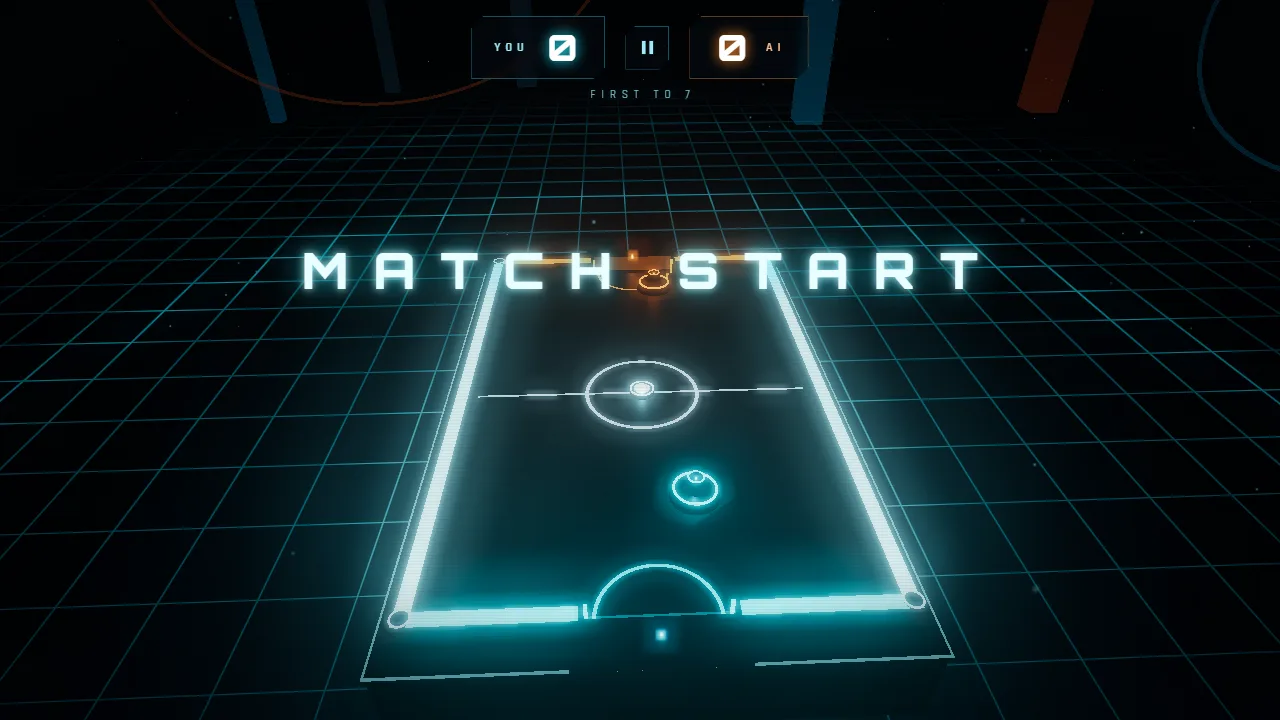
The first player to seven goals wins. You control the cyan paddle at the near end of the table and your opponent the orange one at the far end. Each paddle is held to its own half, right up to the centre line; the puck can go anywhere.
The goal is a slot in the middle of each end wall, a little under a third of its width. The posts at either side of it are solid, so a puck that clips one bounces away rather than going in.
After a goal, the player who conceded receives the puck. It appears in their half and slides gently towards them after a short "get ready", so whoever just let one in always gets the first touch. When either player reaches six, the game marks match point. From the fourth hit of a rally a counter shows how long it has lasted.
How the puck moves
Three things decide almost everything that happens on the table:
- The puck slows down quickly. It loses more than half of its speed every second, so a soft shot dies in the middle of the table while a hard one crosses it in a fraction of a second.
- The walls barely slow it at all. Side walls and end walls hand back 97 per cent of the puck's speed. A bank shot arrives almost as fast as a straight one.
- Your paddle adds its own speed. The puck comes off a paddle a little faster than it arrived, and the paddle's own movement is added on top. A paddle moving into the puck sends it much harder than one held still.
Every paddle hit also sends the puck away at a minimum speed, and that minimum climbs with each hit of a rally until around the eighteenth. Long rallies really do get faster, up to the table's top speed, which is why they usually end with somebody mistiming a block.
The puck goes off in the direction from the centre of your paddle through the centre of the puck at the moment they touch. Catch it on its left side and it goes right; catch it on its right side and it goes left. Aiming is about where you meet the puck, not which way you swing.
Attacking
- Hit through the puck. Come at it from behind, moving towards the target, and keep moving through the contact. A stationary paddle only returns the puck; a moving one shoots it.
- Use the walls. Because the walls keep nearly all the speed, a shot that comes off a side wall arrives at the goal from an angle the keeper has to move across to cover. Aim for the far side of the goal off the near wall.
- Shoot when the keeper is moving. A goalkeeper that has just moved to one side to block cannot get back in time for a quick return to the other.
- Do not waste soft shots. A puck that dies in your opponent's half hands them a free, set-up strike. Shoot hard or keep the puck.
Defending
- Stand in front of your goal, not on the line. A paddle a little way out covers more angles than one sitting on the goal line, and leaves an attacker only the edges of the goal to aim at.
- Watch for the bank into the far side. The dangerous shot is the one off the side wall into the side of the goal away from it. Move across early when you see the puck heading for a wall.
- Do not chase into the corners. A puck going into your corner comes back off the end wall at nearly full speed. Wait for it to come out and meet it.
- When the puck is slow in your half, take your time. Get behind it, line it up with a target and then strike. There is no hurry: your opponent cannot reach it.
- Use the receive. After you concede, the puck comes to you slowly. That is a free shot: set up behind it before it arrives.
Beating the computer
The house paddle is built to be beatable rather than perfect, and the way it decides what to do is worth knowing:
- It only attacks a slow puck. When the puck is in its half, moving slowly and not tight against a wall, it lines up behind it and strikes towards your goal. When the puck is fast it stays home and defends. Hard shots keep it defending.
- It reads one bounce, not two. As a shot comes towards it, the computer works out where the puck will cross its goal area, allowing for one bounce off a side wall. A shot that zig-zags off both walls shows it its true line only after the first bounce, leaving it half the time to get across.
- It reacts a little late. It is working from where the puck was about a tenth of a second ago, and while it is waiting its position drifts and twitches. Quick changes of direction catch it out.
- You are faster. Your paddle can move at nearly twice the computer's top speed, even when it lunges for a strike. You can always reach a spot before it can, so play to the side it is not covering.
- It clears its corners. When the puck sits slowly deep in its own end it comes forward to clear it, which briefly leaves the goal open to a fast return.
There is one level, so the same habits work every time: hit hard, bank off the walls, and make the puck change direction near its goal.
Playing a friend online
Choose Play a Friend, open a table and share the four-letter code; your friend types it in from the same menu. The player who opened the table runs the puck, and the SyphonGames server relays it to the other machine and keeps the score. A player a long way from the server sees the puck arrive slightly later than the host does, so it plays best between people on the same side of the world. For a rematch, open a new table; it takes one click.
Controls and settings
Move the mouse and your paddle follows it; on a touchscreen, drag the paddle with a finger. P or Esc pauses, and a game against the computer pauses itself if you switch to another tab. Settings has the sound volume, a mute switch, graphics quality and full screen. The goal effects flash, and there is a photosensitivity warning on the way in.
Ready to play?
Syphon's Neon Air Hockey runs in your browser, free, with nothing to install. Play Syphon's Neon Air Hockey now, or browse the categories for something else.
More guides
- Playing online with friends
- Keepsies: a guide to mibs, marbles and the eight Rings
- Little Bubbling: a guide to brewing, selling and staying out of the cells
- Syphon's Slap Arena: how to slap harder, defend and win the Slap League
- Chaos Island: how to survive every disaster
- Camp Kindling: a guide to your first nights
- Tall Tails: a fishing guide
- Contrail Cup: planes, stages and racing tips
- Pulsar League: a beginner's guide to rocket football
- Packfall: playing with your dog, and staying alive
- Acheron: a guide to your first escape
- Secret of Rapture: a spoiler-light guide
- Veyrfall: a tactics guide to the Broken Dominion
- Greenside: a golf guide to all nine holes
- Road Riot: a guide to fighting, racing and staying out of handcuffs
- Lockdown: Undead strategy: how to survive more rounds
- Survillian guide: how to survive, level up and prestige
- Tilt guide: three stars, every world and the level editor
- Neon Rush tips: how to run further and score higher
- Lineflow guide: how to build tracks that flow
- Blackjack basic strategy: when to hit, stand, double or split
- How to play Texas Hold'em: hands, odds and position
- 8 ball pool rules: fouls, ball in hand and how to win
- Bowling scoring explained: strikes, spares and the 10th frame
Spotted something out of date? Games here are updated often, so tell us through the contact page and we will fix the guide.