
Protocol: Biomass guide: survive longer in the dark
Updated 1 November 2026
Protocol: Biomass is a top-down survival shooter played in the dark. You are subject BM-01, with a flashlight, a rifle and a dash, in a reactor room that fills with flesh-mass from every side. There is no winning: the run lasts until your vitals hit zero, and the score is how long you lasted and how much you killed. This guide explains exactly how the waves grow, what each enemy does, and how to spend your mutations.
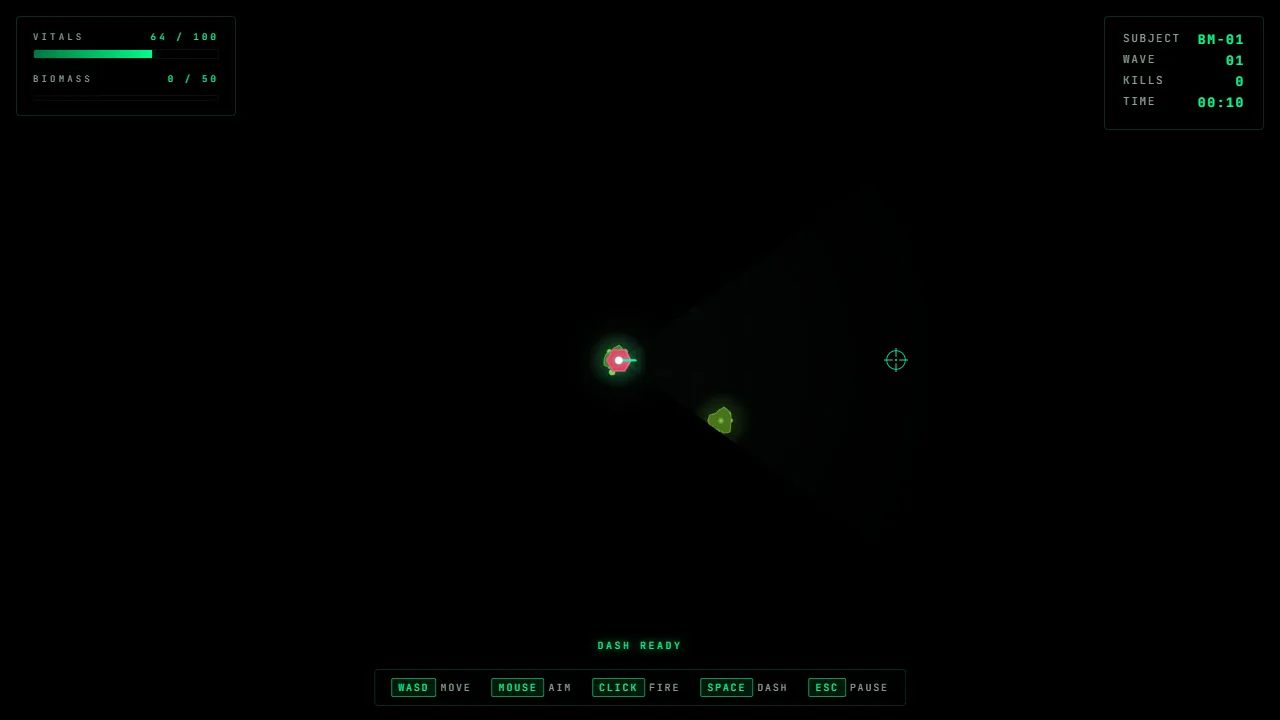
Controls
- W A S D to move, the mouse to aim, click (or hold) to fire.
- Space to dash. Esc pauses, with volume and full-screen options.
- On a touch screen, the left thumb moves and the right aims and fires, with a button to dash. The game needs a phone held sideways.
The dark
The room is unlit. Your flashlight throws a cone about 70 degrees wide in the direction you aim, and a small pool of light surrounds you. Anything outside the light is hard to see, so where you point the gun is also where you can see. Sweep the cone around when the room is quiet, and listen: the sound tells you a lot about what is coming. Headphones help.
The dash
The dash is a short, very fast burst that makes you completely untouchable while it lasts. It goes the way you are moving, or the way you are aiming if you are standing still, and recharges in 1.2 seconds. You cannot fire during it.
- Use it to go through a gap in a crowd, not just away from one. Nothing can hurt you mid-dash.
- After any hit you get half a second of protection before the next one can land, so a crowd cannot shred you instantly, but every contact still hurts.
- Keep it charged. The most common death is dashing to reposition, then having nothing left when a stalker arrives.
The enemies
- Crawlers: the basic flesh-mass. Slower than you, fragile (two shots kill one), and do 12 damage on contact. Drop 3 biomass.
- Stalkers, from wave 2: the fastest thing in the room, nearly as quick as you, and take three shots. 16 damage on contact. Drop 6 biomass.
- Brutes, from wave 3: big and slow, but they take six shots and hit for 28. Drop 12 biomass.
You are faster than all of them, which is why moving keeps you alive. They simply come straight at you from the edges of the room. Every one that touches you hurts, and touching repeats every 0.6 seconds while it stays in contact.
How the waves grow
A new wave starts every 25 seconds, whatever you are doing; there is nothing to clear. With every wave, enemies arrive more often, and from wave 4 (wave 5 on a phone) they arrive in groups that get bigger every few waves. By the later waves, the spawning never really stops.
So the game is about space. Standing in a corner feels safe until the room fills from two sides. Keep moving through the middle, keep the gun on the side they are thickest, and leave yourself a way out.
Biomass and mutations
Killing enemies drops biomass gems. Gems drift towards you once you are close, but they fade after about 12 seconds, so you have to go back out and collect them. Each gem fills the biomass meter by one. When it is full, the game pauses and offers a mutation, and the next one needs half as much biomass again: 50, then 75, then 112, and so on. Every mutation also restores 50 health.
There are three mutations, and you can take any of them more than once; their effects stack:
- Chitinous Plating (heavy path): +30 maximum health and 60% larger bullets, which makes them easier to land, but 15% slower movement.
- Acid Glands (control path): every hit leaves a corrosive pool for 3 seconds that keeps damaging anything standing in it.
- Elongated Tendrils (agility path): half as much dash distance again, a 35% shorter dash recharge, and 25% faster firing.
Which mutations to take
- Acid Glands first. Taking it once is enough to turn every bullet into area damage. Against packs coming down the same path, the pools do a lot of the killing for you. Taking it again adds nothing.
- Tendrils next, more than once. Faster fire and a shorter dash recharge help with every problem the game throws at you, and each pick stacks on the last.
- Plating when you need to survive, not to kill. The extra health is welcome once brutes appear, but every pick makes you slower, and speed is how you escape. One or two is plenty.
- Time your collecting. Since a mutation heals 50, a nearly full meter is an emergency heal. When you are low, go and get the gems.
Scoring a run
When you fall, the game shows your kills, the wave you reached, the time you survived and the mutations you took. Those four numbers are the measure of a run, so try to beat your last one on each.
Ready to play?
Protocol: Biomass runs in your browser, free, with nothing to install. Play Protocol: Biomass now, or browse the categories for something else.
More guides
- Playing online with friends
- Keepsies: a guide to mibs, marbles and the eight Rings
- Little Bubbling: a guide to brewing, selling and staying out of the cells
- Syphon's Slap Arena: how to slap harder, defend and win the Slap League
- Chaos Island: how to survive every disaster
- Camp Kindling: a guide to your first nights
- Tall Tails: a fishing guide
- Contrail Cup: planes, stages and racing tips
- Pulsar League: a beginner's guide to rocket football
- Resonance: Two Voices guide: playing with your voice, both roles and the bosses
- Shrap guide: weapons, maps, modes and winning gunfights
- Packfall: playing with your dog, and staying alive
- Acheron: a guide to your first escape
- Secret of Rapture: a spoiler-light guide
- Veyrfall: a tactics guide to the Broken Dominion
- Los Pantalones guide: story, gangs, money and losing the cops
- Sigilclash guide: card rules, captures, deck building and the campaign
- Drakonia guide: hatching, care, missions, battles and evolution
- Dragon Egg Traders guide: towns, prices, poachers and reaching 100,000 gold
- Greenside: a golf guide to all nine holes
- Road Riot: a guide to fighting, racing and staying out of handcuffs
- Scorch Circuit guide: weapons, the championship, upgrades and staying alive
- Pocket Grand Prix guide: drifting, turbos and faster laps
- Snowbound guide: faster runs, clean landings and every gate
- Lockdown: Undead strategy: how to survive more rounds
- Survillian guide: how to survive, level up and prestige
- Voidlance guide: weapons, the Prism Core and all five bosses
- Blast Grid guide: charges, power-ups, enemies and every arena hazard
- Tilt guide: three stars, every world and the level editor
- Neon Rush tips: how to run further and score higher
- SydeScroller guide: jumping, obstacles, power-ups and longer runs
- Encore guide: cues, ghosts, the Hook and how to last longer
- Lineflow guide: how to build tracks that flow
- Physics puzzle games: Cannon Crush, Gravity Breaker, Bankshot and Frog Delivery Service
- Short story games: Scales of Justice, Department of Lost Things, One Minute to Extinction and more
- Quick arcade games: Freefall, Reality Rumble, Prism Pop, Snack Attack, 60 Second Sketch and Breakout
- Blackjack basic strategy: when to hit, stand, double or split
- How to play Texas Hold'em: hands, odds and position
- 8 ball pool rules: fouls, ball in hand and how to win
- How to play pinball: rules, scoring and tips for both tables
- Air hockey rules and tips: how to score and defend
- Bowling scoring explained: strikes, spares and the 10th frame
Spotted something out of date? Games here are updated often, so tell us through the contact page and we will fix the guide.