
Snowbound guide: faster runs, clean landings and every gate
Updated 1 November 2026
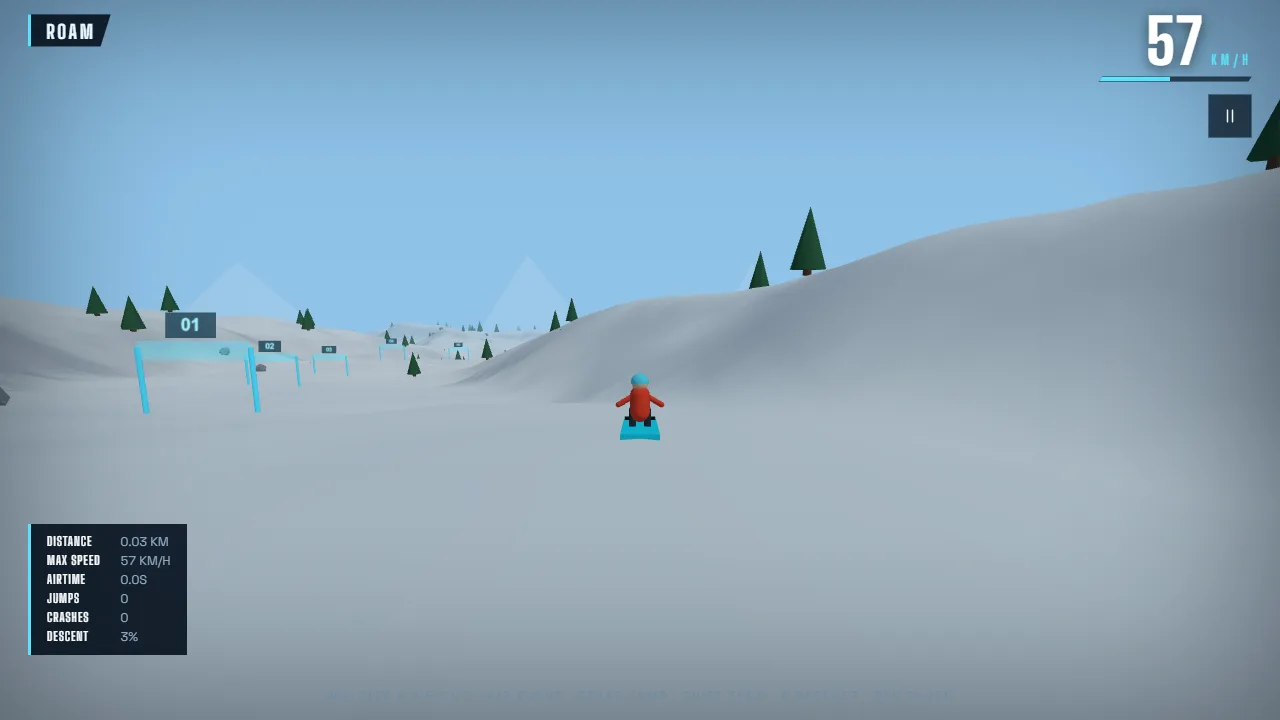
Snowbound is a downhill snowboarding game with two ways to ride the same mountain: Free Ride, with no clock and no gates, and Time Trial, a race from the summit to the valley through 16 checkpoint gates. The mountain is the same every time you play, so a fast run is about learning one line and riding it cleanly. This guide explains how the board actually handles and where time is won and lost.
Controls
- Ride / pump: W or ↑. Brake: S or ↓.
- Carve: A D or ← →. Or click the snow to lock the mouse and steer with it, which is smoother once you are used to it; Esc releases the mouse and pauses.
- Jump: Space. Tuck: Shift.
- In the air: W tips the nose down, S tips it up.
- Recover: R puts you back on the course. Full screen: F.
A gamepad works too (left stick to carve, right trigger to ride, left trigger to brake, A or Cross to jump, B or Circle to recover), and on a touch screen there are on-screen buttons for left, right, tuck, brake and jump.
How speed works
- The slope does most of the work. Gravity pulls you down the fall line, so you are fastest pointing straight downhill and slower the further across the slope you point.
- Riding and tucking add to it. W and Shift each push you on, and holding either also cuts your air resistance. Hold both on a straight run for the most speed.
- Turning costs speed. The harder you carve, the more you scrub off, and it builds up through a long turn. Flat ground slows you down too.
- There is a ceiling of about 119 km/h, and wind resistance grows with speed, so the last few km/h take a long straight to reach.
The practical lesson: commit to a line early. Several small corrections cost more speed than one smooth, early turn, and a turn started late has to be harder.
Jumps and landings
You leave the ground when you press Space, or on your own when you go over a lip at speed. In the air, your speed is carried, and W and S no longer push or brake: they tilt the board. If you do nothing, the board slowly levels itself with your flight path, which keeps small hops safe.
Two things decide how a landing goes: how fast you are coming down, and how well the board matches the slope you land on.
- Stomped: real air, more than a second off the ground, landed with the board close to the angle of the slope. The game shows STOMPED IT! and you keep all your speed.
- Clean: a small hop with the board close to the angle of the slope. You keep all your speed.
- Sketchy: the board noticeably off the slope, or coming down hard after a short time in the air, such as dropping off a steep edge. You lose more than a quarter of your speed.
- Wipeout: a very long drop, a long drop landed nose- or tail-first, or the board badly wrong on any landing. You stop for well over a second and get up slowly.
So set the board up before you land: on a steep landing, tip the nose down with W; on a flatter one, level off with S. Big air costs nothing if you land it matched, but the same jump landed with the board off the slope costs a quarter of your speed, so in a race only go big where you have time to set up the landing.
Trees and rocks
Clipping a tree or rock at any real speed is a wipeout. At low speed you bump off. If you get stuck for six seconds the game puts you back on the course itself, or press R to recover straight away.
Time Trial
The race runs from the summit to the finish valley through 16 numbered gates, in order.
- A missed gate adds 5 seconds. Passing outside the flags counts as a miss. The gates are 18 metres wide with a little give at each side, so there is room to take them at an angle.
- A recovery adds 2 seconds in Time Trial, whether you press R or the game does it for you, and you restart slowly. It is still better than fighting your way out of trees.
- Splits. Each gate shows your time, and once you have a personal best, how far ahead (green) or behind (red) of it you are. Use the splits to find which part of the mountain costs you time.
- Penalties count. Your result is your riding time plus every penalty, so a run that misses one gate has to be five seconds quicker on the snow to beat a clean one.
The ten fastest times are kept on a local leaderboard with a name against each.
Tips for a faster run
- Learn the course in Free Ride. It is the same mountain without the clock. Ride it until you know where the gates and the big drops are.
- Look two gates ahead. The fastest line through a gate is the one that sets you up for the next, not the straightest line to this one.
- Tuck on the straights, not in the turns. Tucking adds speed you then have to scrub off in a turn.
- Do not jump for the sake of it. A jump only helps if it clears something slower, and a landing you have not set up costs more speed than the jump saves.
- A clean run beats a fast one. One wipeout or missed gate wipes out what a lot of good riding gained.
Settings
Settings has master, music and effects volume, three graphics quality levels, camera shake and camera sensitivity. Your settings and leaderboard are saved in your browser.
Ready to play?
Snowbound runs in your browser, free, with nothing to install. Play Snowbound now, or browse the categories for something else.
More guides
- Playing online with friends
- Keepsies: a guide to mibs, marbles and the eight Rings
- Little Bubbling: a guide to brewing, selling and staying out of the cells
- Syphon's Slap Arena: how to slap harder, defend and win the Slap League
- Chaos Island: how to survive every disaster
- Camp Kindling: a guide to your first nights
- Tall Tails: a fishing guide
- Contrail Cup: planes, stages and racing tips
- Pulsar League: a beginner's guide to rocket football
- Resonance: Two Voices guide: playing with your voice, both roles and the bosses
- Shrap guide: weapons, maps, modes and winning gunfights
- Packfall: playing with your dog, and staying alive
- Acheron: a guide to your first escape
- Secret of Rapture: a spoiler-light guide
- Veyrfall: a tactics guide to the Broken Dominion
- Los Pantalones guide: story, gangs, money and losing the cops
- Sigilclash guide: card rules, captures, deck building and the campaign
- Drakonia guide: hatching, care, missions, battles and evolution
- Dragon Egg Traders guide: towns, prices, poachers and reaching 100,000 gold
- Greenside: a golf guide to all nine holes
- Road Riot: a guide to fighting, racing and staying out of handcuffs
- Scorch Circuit guide: weapons, the championship, upgrades and staying alive
- Pocket Grand Prix guide: drifting, turbos and faster laps
- Lockdown: Undead strategy: how to survive more rounds
- Survillian guide: how to survive, level up and prestige
- Protocol: Biomass guide: survive longer in the dark
- Voidlance guide: weapons, the Prism Core and all five bosses
- Blast Grid guide: charges, power-ups, enemies and every arena hazard
- Tilt guide: three stars, every world and the level editor
- Neon Rush tips: how to run further and score higher
- SydeScroller guide: jumping, obstacles, power-ups and longer runs
- Encore guide: cues, ghosts, the Hook and how to last longer
- Lineflow guide: how to build tracks that flow
- Physics puzzle games: Cannon Crush, Gravity Breaker, Bankshot and Frog Delivery Service
- Short story games: Scales of Justice, Department of Lost Things, One Minute to Extinction and more
- Quick arcade games: Freefall, Reality Rumble, Prism Pop, Snack Attack, 60 Second Sketch and Breakout
- Blackjack basic strategy: when to hit, stand, double or split
- How to play Texas Hold'em: hands, odds and position
- 8 ball pool rules: fouls, ball in hand and how to win
- How to play pinball: rules, scoring and tips for both tables
- Air hockey rules and tips: how to score and defend
- Bowling scoring explained: strikes, spares and the 10th frame
Spotted something out of date? Games here are updated often, so tell us through the contact page and we will fix the guide.