
Physics puzzle games: Cannon Crush, Gravity Breaker, Bankshot and Frog Delivery Service
Updated 1 November 2026
These four games run on real physics: weight, gravity, bounces and momentum. That makes them quick to pick up and slow to master, because each one does exactly what you told it to, not what you meant. Here is what each game asks of you, how its scoring works, and the details that make the difference.
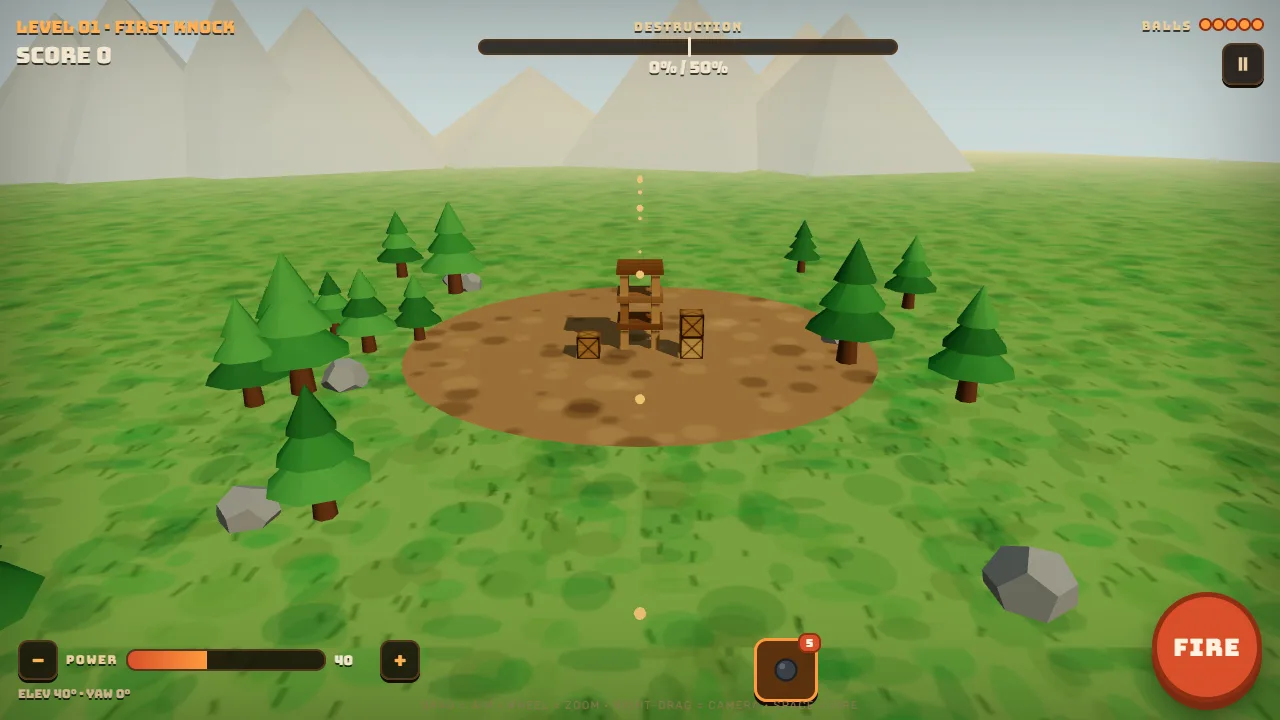
Cannon Crush
Cannon Crush gives you a cannon, a handful of cannonballs and a structure of wood, stone and metal to knock down. There are twelve levels, from First Knock to the Grand Fortress, each unlocked by clearing the one before.
Controls
- A D or ← → turn the cannon; W S or ↑ ↓ raise and lower it. You can also drag to aim with a mouse or a finger.
- Q and E, the POWER meter or its − and + buttons set the power.
- Space or FIRE launches a ball, and 1 to 4 choose the ammunition.
- The mouse wheel or a pinch zooms, a right-drag or two fingers orbit the camera, and R resets it. Esc pauses.
A dotted arc shows where the ball would come down if nothing were in the way, so you can see the effect of every change before you fire.
How you win
Each level has a target, from 50% of the structure on the first level up to 76% on the last. The bar at the top fills as blocks go: a block you smash counts in full, and a block you only knock loose, moved or tipped over, counts for 65%. Metal is worth the most, then stone, then wood and crates. Red barrels explode, taking out what is around them. Run out of cannonballs before you reach the target and the level is lost.
Stars: one for clearing the level, two if you clear it with at least one ball to spare, and three if you bring down 20 points more than the target (95% at most). Every ball left over is also worth 500 points, and breaking three blocks in quick succession earns a 300-point multi hit. Your stars, best scores and unlocked levels are saved.
Ammunition
- Standard ball: the workhorse.
- Blast ball (from Twin Spires): explodes on the first thing it touches.
- Heavy ball (from The Old Bridge): bigger and over twice as heavy, for stone.
- Cluster ball (from Guarded Keep): bursts into five fragments on the first thing it hits, spraying damage over a wide area.
If the type you have selected runs out, the cannon fires the next type you still have.
Tips
- Hit what holds the rest up. Toppled blocks count too, so a ball through a supporting post or the bottom of a tower can bring down far more than one aimed at the top.
- Use the barrels. A barrel goes off when it breaks, and it is often worth aiming for one before anything else.
- Save the blast and heavy balls for the stone and metal that a standard ball barely dents.
- Wait for the dust to settle. Structures keep falling for a moment after a hit, and the bar keeps counting.
Gravity Breaker
In Gravity Breaker you launch a probe and let gravity steer it. Planets, moons, suns and black holes all pull on it, and the target is never where a straight shot would go. There are 25 levels in five sectors: First Orbit, Slingshot, Twin Suns, the Broken System and Event Horizon.
Aiming
- Move the mouse to aim, drag away from the launcher to set the power, and let go to launch. On a touchscreen, drag and release. The mouse wheel fine-tunes the power.
- On a keyboard, A D or the arrows aim, W S set the power and Space launches. R restarts the level and Esc or P pauses.
- While you aim, a dotted line predicts about seven seconds of the flight, moving bodies included. A cross marks where the probe would crash, and any target it would hit lights up.
Once the probe is away you have no control over it. If it is stuck in a hopeless orbit, you can recall it after two seconds of flight, but it still counts as one of your probes.
Probes, par and stars
Each level gives you a few probes, usually three, and a par: the number of probes it should take, usually two. Use no more than par for three stars, one more for two, and any more for one. Run out of probes and the level is failed. Your best stars, fewest probes and fastest time on each level are saved.
What ends a flight
When a probe is lost, the game says why, and each reason points to a different fix:
- Shattered on impact: it hit a planet, moon or rock. Aim wider or launch faster.
- Burned up in the corona: it flew into a sun. Suns pull hard; give them more room.
- Consumed by the black hole: the pull reaches a long way, so pass much further out.
- Drifted beyond the system: too fast or the wrong way. Use less power, or let a body bend it back.
- Exhausted its momentum: still flying after 26 seconds, usually trapped in an orbit.
Strange space
Later levels add wormholes, which move the probe to their partner and keep its momentum, with a little extra speed; hidden wells, invisible pulls you only learn about from the predicted path; amplifiers, which multiply gravity inside their field; and rings of debris that rotate, so you have to time the gap. Some targets move, and some levels ask for more than one target with a single probe.
Tips
- Trust the dotted line, then adjust it. Small changes in angle make big changes at the far end, so move in tiny steps.
- Slingshot. Passing close behind a heavy body throws the probe out faster than it went in; that is how you reach the far side of the system.
- Read the level hint. Each level's one-line hint describes the trick it wants.
Bankshot
Bankshot is a turn-based duel with marbles. Everyone starts on 100 health, and the twist is that a shot gets stronger every time it bounces, so the straight shot is almost never the right one.
A turn
- First, if you like, drag your marble to a new spot inside the ring around it. Sliding over a power-up picks it up.
- Then drag out from your marble and let go to shoot. The longer the drag, the faster the shot.
- A dotted guide shows the path for the first five bounces only. The last two damage levels are never shown, so the biggest shots are always partly guesswork.
Damage
Every wall, block and bumper the shot touches moves it up the ladder:
- A straight hit with no bounces does 10. Then 16 after one bounce, 25 after two, 38 after three, 55 after four and 72 after five, and 90 after six or more.
- The shot changes colour as it climbs, and the game calls out each hit: Clean Hit, Bank Shot, Double Bank, Triple Bank, Four Walls, Unreal and finally Bankshot King.
- A shot that has bounced even once can hit you, at full strength. A shot fizzles out after about three seconds or once it has bounced more than seven times.
The arena
Every round uses one of eight mirrored layouts. Blocks bounce shots, and some of them are breakable and give way after three hits. Round bumpers count as a bounce and speed the shot up. Two power-ups appear at the start of each round, and another every six turns, up to three on the table:
- Charged: your next shot starts two bounces up the ladder, so even a straight hit does 25.
- Split: after its first bounce, the shot splits into three.
- Heavy: smashes straight through breakable blocks instead of bouncing off them.
- Guard: blocks the next hit on you completely.
- Patch: 30 health back at once.
You carry one shot power-up at a time, used on your next shot. If a round goes past twenty turns, the table starts taking health from everyone every turn, and more as it goes on, so nobody can stall.
Modes
- Duel: two to four players on one screen, each a person or a computer opponent (Rookie, Pro or Shark). Choose how many rounds win the match and whether there is a 30-second turn clock. The end screen shows the best bank of the match.
- Survive: you against waves of computer opponents, one at first, then two from wave 4 and three from wave 7, getting stronger and tougher as you go. You get 30 health back after each wave. Each hit scores its damage plus 20 for every bounce, clearing a wave adds 250 times the wave number, and your best score is saved on your device.
Tips
- Two or three banks is the sweet spot. 25 to 38 damage is reliable; a five-bank shot is huge but hard to land and can come back for you.
- Move before you shoot. A few steps can open a clean two-wall angle, or take you out of your opponent's best line.
- Save Charged for a sure thing. On a two-bank shot it lands like a four-bank one.
- Watch the corners. A shot into a corner comes straight back out.
Frog Delivery Service
You are a frog with a parcel to deliver. Pick it up near the start, get it across the level to the customer at the far end, and keep it in one piece on the way. There are ten deliveries, from Backyard Blunder to Mount Deliverance.
Controls
- A D or ← → to walk.
- Hold Space, W or ↑ to crouch and charge a jump, and let go to jump. The longer the hold, the higher the jump, but you move slowly while charging. On the tall climbing walls in some levels, pressing against the wall slows your fall, and a jump kicks you off it.
- The tongue is the mouse button, E or Shift. With a mouse it shoots towards the pointer; on a keyboard it goes up and forwards, or up towards whichever way you are pressing.
- R restarts the delivery, M mutes, Esc goes back to the menu. On a touchscreen there are buttons for left, right, jump and tongue.
The tongue
The tongue latches on to the gold anchor rings hanging around each level, not to walls or floors. Keep holding the button and you swing from the ring while the tongue slowly reels you in; let go to fly off. Letting go on the upswing carries you furthest. The tongue does other jobs too: it collects tips (the coins), stuns dogs, rats, birds, fish and frisbees for a couple of seconds, and yanks a dropped parcel back to you.
The parcels
The parcel's condition starts at 100%. Hard landings while carrying it wear it down, and so does anything that knocks you, which also makes you drop it. Each parcel behaves differently:
- Mystery Parcel: fairly robust. The first delivery.
- Birthday Cake: by far the most fragile. Short hops and gentle landings.
- Fishbowl: the water sloshes when you start, stop or turn sharply, and spills cost condition. Change speed smoothly.
- Bowling Ball: nearly unbreakable but heavy. Your jumps are feeble and you fall fast, but landing on crates smashes them.
- Giant Balloon: you barely fall, the wind pushes you about, and fans throw you a long way. One touch of spikes pops it, and if you drop it, it floats away.
- Glowing Egg: fragile, and it squirts out of your arms every few seconds, sooner if you are moving fast. Catch it before it lands.
- Angry Chicken: flaps and shoves you about, and every few seconds may break free and run off. Tongue it back before it gets away.
The delivery fails if the parcel's condition reaches zero, if the parcel falls in water or lava, if you or it fall off the level, if the balloon floats off into the sky, or if the chicken escapes.
Scoring and stars
A delivery scores 500, plus 8 for every percent of condition left, plus a bonus for beating the level's par time, plus 60 for every tip. Stars: one for delivering, one more for arriving in at least 70% condition, and one more for beating par. Progress is not saved between visits, so play the ten deliveries in one sitting.
Tips
- Swing rather than hop where there are rings: it is faster and gentler on the parcel than a long fall.
- Do not charge every jump. A full-height jump means a long fall, and the landing is what does the damage.
- Stun animals before you pass them. A tongue to a dog is much cheaper than being knocked back and dropping the parcel.
- Grab the parcel back quickly. A dropped parcel takes damage every time it bounces.
Ready to play?
All of these run in your browser, free, with nothing to install.
More guides
- Playing online with friends
- Keepsies: a guide to mibs, marbles and the eight Rings
- Little Bubbling: a guide to brewing, selling and staying out of the cells
- Syphon's Slap Arena: how to slap harder, defend and win the Slap League
- Chaos Island: how to survive every disaster
- Camp Kindling: a guide to your first nights
- Tall Tails: a fishing guide
- Contrail Cup: planes, stages and racing tips
- Pulsar League: a beginner's guide to rocket football
- Resonance: Two Voices guide: playing with your voice, both roles and the bosses
- Shrap guide: weapons, maps, modes and winning gunfights
- Packfall: playing with your dog, and staying alive
- Acheron: a guide to your first escape
- Secret of Rapture: a spoiler-light guide
- Veyrfall: a tactics guide to the Broken Dominion
- Los Pantalones guide: story, gangs, money and losing the cops
- Sigilclash guide: card rules, captures, deck building and the campaign
- Drakonia guide: hatching, care, missions, battles and evolution
- Dragon Egg Traders guide: towns, prices, poachers and reaching 100,000 gold
- Greenside: a golf guide to all nine holes
- Road Riot: a guide to fighting, racing and staying out of handcuffs
- Scorch Circuit guide: weapons, the championship, upgrades and staying alive
- Pocket Grand Prix guide: drifting, turbos and faster laps
- Snowbound guide: faster runs, clean landings and every gate
- Lockdown: Undead strategy: how to survive more rounds
- Survillian guide: how to survive, level up and prestige
- Protocol: Biomass guide: survive longer in the dark
- Voidlance guide: weapons, the Prism Core and all five bosses
- Blast Grid guide: charges, power-ups, enemies and every arena hazard
- Tilt guide: three stars, every world and the level editor
- Neon Rush tips: how to run further and score higher
- SydeScroller guide: jumping, obstacles, power-ups and longer runs
- Encore guide: cues, ghosts, the Hook and how to last longer
- Lineflow guide: how to build tracks that flow
- Short story games: Scales of Justice, Department of Lost Things, One Minute to Extinction and more
- Quick arcade games: Freefall, Reality Rumble, Prism Pop, Snack Attack, 60 Second Sketch and Breakout
- Blackjack basic strategy: when to hit, stand, double or split
- How to play Texas Hold'em: hands, odds and position
- 8 ball pool rules: fouls, ball in hand and how to win
- How to play pinball: rules, scoring and tips for both tables
- Air hockey rules and tips: how to score and defend
- Bowling scoring explained: strikes, spares and the 10th frame
Spotted something out of date? Games here are updated often, so tell us through the contact page and we will fix the guide.