
Quick arcade games: Freefall, Reality Rumble, Prism Pop, Snack Attack, 60 Second Sketch and Breakout
Updated 1 November 2026
Six games you can pick up in a minute: a skydive, a party brawl, a match-three puzzle, a platformer inside a vending machine, a drawing game and the original brick breaker. Each has a few rules that are not obvious from the first go, and this guide covers them, along with how the scoring works.
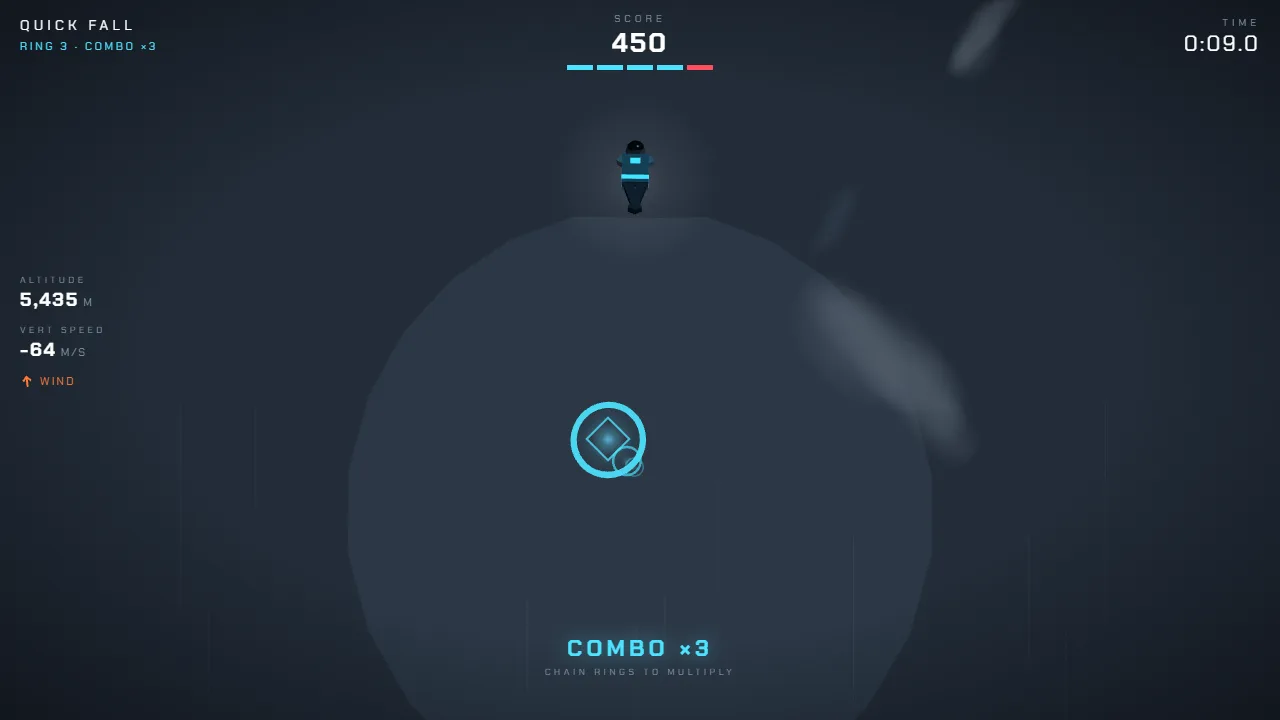
Freefall
You are skydiving through rings, always falling, steering where you fall rather than how fast. There are five stages, Cloud Break, Storm Run, Skyline, Canyon Drop and Terminal Descent, each ending at a big green finish gate, plus Quick Fall, an endless mode.
Controls
- W A S D or the arrow keys steer.
- Hold Space to brake, which roughly halves your fall speed while you hold it.
- R restarts and Esc pauses. On a touchscreen there is a stick and a BRAKE button.
Rings and combos
- A ring passed through scores 100, or 150 for a perfect: the inner third of the ring.
- Every ring in a row raises your combo, and each ring's points are multiplied by it. Miss one and the combo is gone.
- Coloured rings do more. Orange ones speed your fall up for six seconds, purple ones slow it for five, and pink ones add an extra step to your combo. Gold rings are smaller and harder to hit, and some rings in the later stages move.
Integrity and the ground
Balloons, drones, beams, rocks and columns are in the way. Hitting one costs integrity, 150 points and your combo, and knocks you sideways; integrity creeps back after four seconds without a hit. Lose it all and the run is over, and in a stage, so is missing the finish gate and reaching the ground. On Storm Run, Skyline, Canyon Drop and Terminal Descent, gusts of wind push you about; the WIND arrow shows which way.
Ranks
Reaching the finish gate adds 5,000 points and a bonus for beating the stage's par time. Your rank depends on the share of rings you hit: A for 85% or more, B for 70%, C for 50%, and D below that. An S needs 95% of the rings and a time well under par. Best scores, times and ranks are saved, along with a top-ten leaderboard and twelve achievements.
Tip: look one ring ahead. The line that lands you centred in the next ring is rarely the straight one, and a perfect is only worth chasing if you can still reach the ring after it.
Reality Rumble
A side-on brawl between six riftlings, you and five computer opponents, over three rounds. Each opponent has a personality, from the Cautious to the Aggressive to the Portal-Obsessed, and they play like it.
Controls
- A D or ← → to move.
- Space, W or ↑ to jump; hold it for a higher jump.
- Shift to dash, a short burst that shoves anyone you hit. The DASH bar shows when it is ready again, a little over two seconds later.
- P or Esc to pause. On a touchscreen the buttons appear by themselves.
Shifts and objectives
Before each round, the game announces its reality shift: a new rule of physics for that round, such as Gravity Flip, Tiny Planet, Jelly Floor, Rift Rain, Clone Panic, Magnet Mayhem, Reverse World, Growing Disaster, Shrink Storm, The Void Is Hungry, Meteor Fruit, Colour Curse, Time Glitch or Inside Out. The final round often stacks two at once.
It also announces the objective. Usually it is to be the last riftling standing, but a round can instead be a Reality Shard Rush, the Shrinking Arena, the Hot Dimensional Potato, Portal Escape, or Safe Zone Pulses. Read the banner before the round begins: knocking everyone off is no help in a shard rush.
Power-ups
Glowing power-ups appear during a round: Zoomies (faster running), Moon Legs (higher jumps), Absolute Unit (three times as hard to push around), Butterfly Mode (much lighter gravity), Phase Out (others pass straight through you) and Repulsor Blast (an instant shove in every direction).
Scoring
Each round ranks everyone: first place earns 10 points, then 8, 6, 4 and 2, and last place nothing. Shards are worth 3 each in a shard rush, and escaping early through a portal earns extra. Points carry over, and after three rounds the highest total wins. If you are knocked out, you watch the rest of the round.
Tip: the dash is your best attack and your best escape, so do not waste it. A dash that misses near an edge can carry you over it.
Prism Pop
A match-three puzzle: swap two neighbouring gems to make a line of three or more of the same colour. The board is eight by eight, with seven colours, Ruby, Solar, Luxor, Verdi, Aqua, Volt and Nova, and there are 24 levels, each with a move limit, from 32 moves down to 20.
Goals
The goal changes from level to level: reach a score; collect a number of gems of one colour, or of two; break all the ice; or clear the crates and, later, stone blocks, which take more than one hit. Ice appears from level 3, crates from level 4, locked gems from level 8, and stone from level 14, so later levels mix goals and obstacles. A level ends as soon as its goal is met; a score level is judged when your moves run out.
Special pieces
- Four in a row makes a line piece, which clears its whole row or column when matched.
- An L or T shape of five makes a bomb, which blasts the area around it.
- Five in a row makes a prism. Swap it with any gem to clear every gem of that colour.
The special piece appears where you made the swap. Swapping two special pieces together sets off something bigger: two lines make a cross; a line and a bomb fire three rows and three columns; two bombs clear a five-by-five square; a prism with a special turns every gem of that colour into that special and sets them all off; and two prisms clear the board.
Stars
Every move you have left when you finish is worth 100 points. Stars come from your score: one for clearing the level, two at 1.4 times its target, and three at 1.85 times. Stars, best scores and unlocked levels are saved. If the board runs out of moves, it reshuffles itself.
Tip: make specials before you need them, and save them for each other. One combo of two specials usually does more than several moves spent on plain matches.
Snack Attack
You live inside a vending machine, and every purchase is a natural disaster. Climb the shelves, collect the coins, and when you have them all the chute at the bottom opens. There are six machines, from Break Room Beauty to Machine 404, which is on the moon.
Controls
- ← → or A D to move.
- Space, ↑ or W to jump; hold it for a higher jump.
- ↓ or S to drop down through the wrapper ledge you are standing on.
- P or Esc to pause, M to mute. On a touchscreen there are arrow buttons.
What happens in the machine
- Purchases: an alarm and a warning mark where a big snack is about to plunge down. Get out of that lane.
- Rolling cans come out of the side along a shelf, usually the one you are on. Jump them.
- The claw drops to a shelf and sweeps across it. Do not be where it sweeps.
- Someone hitting the glass shakes the machine and sends the snacks flying.
- Springs bounce you up a level.
These events come faster the more coins you hold and the later the machine. There are no lives: if you are squashed, you start again from the last shelf you stood on, but more often than not you drop one of your coins nearby. Each machine's coin count, from six to eight, shows at the top. The game is not saved, and the end screen counts your coins and splats over all six machines.
60 Second Sketch
You get a random subject, sixty seconds to draw it, and a score out of 100. Five drawings make a match. The subjects come from animals, people, objects, food, vehicles, places and nature, at easy, medium and hard, plus some absurd ones such as a cat wearing sunglasses.
Tools
A pencil, an eraser, undo and redo, clear, a set of colours and a brush size slider. You can finish early, though with the default judge, using the whole minute scores a little better.
How it is judged
The score is split into subject accuracy, recognisability, detail, composition and creativity, but what decides it depends on the judge:
- By default it uses the Local Judge, which runs in your browser and does not try to recognise the drawing at all. As the game itself notes, it scores ink coverage and effort: a drawing that fills a good part of the canvas without flooding it, made of plenty of strokes, using more than one colour, and using the full minute, scores best. Harder subjects get a small bonus, and there is a little luck in every score.
- In Settings you can connect an AI judge instead, using your own OpenAI-compatible vision service, its address, API key and model. That judge really does look at what you drew. Your drawings are then sent to that service, and the key is kept only in your browser.
Match scores go on a leaderboard kept on your device.
Breakout
The original idea: a paddle, a ball, three lives and a wall of fifty bricks in five rows.
- Move the paddle with the mouse, a finger, or the left and right arrow keys. Click, tap, Space or Enter launches the ball.
- Where the ball hits the paddle sets its angle: dead centre sends it straight up, and the edges send it off at up to 60 degrees. That is how you reach the columns you cannot otherwise get to.
- Bricks in the top row are worth 50, then 40, 30, 20 and 10 for the bottom row, so a full clear is 1,500.
- Every brick speeds the ball up a little, and losing a life resets it to its starting speed.
There is no saved high score; it is a few minutes and a number to beat next time.
Ready to play?
All of these run in your browser, free, with nothing to install.
- Play Freefall
- Play Reality Rumble
- Play Prism Pop
- Play Snack Attack
- Play 60 Second Sketch
- Play Breakout
More guides
- Playing online with friends
- Keepsies: a guide to mibs, marbles and the eight Rings
- Little Bubbling: a guide to brewing, selling and staying out of the cells
- Syphon's Slap Arena: how to slap harder, defend and win the Slap League
- Chaos Island: how to survive every disaster
- Camp Kindling: a guide to your first nights
- Tall Tails: a fishing guide
- Contrail Cup: planes, stages and racing tips
- Pulsar League: a beginner's guide to rocket football
- Resonance: Two Voices guide: playing with your voice, both roles and the bosses
- Shrap guide: weapons, maps, modes and winning gunfights
- Packfall: playing with your dog, and staying alive
- Acheron: a guide to your first escape
- Secret of Rapture: a spoiler-light guide
- Veyrfall: a tactics guide to the Broken Dominion
- Los Pantalones guide: story, gangs, money and losing the cops
- Sigilclash guide: card rules, captures, deck building and the campaign
- Drakonia guide: hatching, care, missions, battles and evolution
- Dragon Egg Traders guide: towns, prices, poachers and reaching 100,000 gold
- Greenside: a golf guide to all nine holes
- Road Riot: a guide to fighting, racing and staying out of handcuffs
- Scorch Circuit guide: weapons, the championship, upgrades and staying alive
- Pocket Grand Prix guide: drifting, turbos and faster laps
- Snowbound guide: faster runs, clean landings and every gate
- Lockdown: Undead strategy: how to survive more rounds
- Survillian guide: how to survive, level up and prestige
- Protocol: Biomass guide: survive longer in the dark
- Voidlance guide: weapons, the Prism Core and all five bosses
- Blast Grid guide: charges, power-ups, enemies and every arena hazard
- Tilt guide: three stars, every world and the level editor
- Neon Rush tips: how to run further and score higher
- SydeScroller guide: jumping, obstacles, power-ups and longer runs
- Encore guide: cues, ghosts, the Hook and how to last longer
- Lineflow guide: how to build tracks that flow
- Physics puzzle games: Cannon Crush, Gravity Breaker, Bankshot and Frog Delivery Service
- Short story games: Scales of Justice, Department of Lost Things, One Minute to Extinction and more
- Blackjack basic strategy: when to hit, stand, double or split
- How to play Texas Hold'em: hands, odds and position
- 8 ball pool rules: fouls, ball in hand and how to win
- How to play pinball: rules, scoring and tips for both tables
- Air hockey rules and tips: how to score and defend
- Bowling scoring explained: strikes, spares and the 10th frame
Spotted something out of date? Games here are updated often, so tell us through the contact page and we will fix the guide.