
Resonance: Two Voices guide: playing with your voice, both roles and the bosses
Updated 1 November 2026
Resonance: Two Voices is an online co-op adventure for two players where the microphone is the controller. One of you is RED, the low voice of mass; the other is BLUE, the high voice of energy. You move with the keyboard or a gamepad, but everything you do to the world, you do by humming and singing. No words are recognised and nothing is recorded. This guide explains how the game hears you, what each voice can do, and how to get through its 21 stages and three bosses together.
Getting into a game
- Quick Play finds you a partner. Create a private room instead to get a five-character code to send to a friend.
- While you wait for a partner, you can play with Echo, an AI partner, and you are called back when a person joins.
- Either of you can play either voice. In the lobby, before you both press ready, you can swap roles. Every stage can be replayed from the other side.
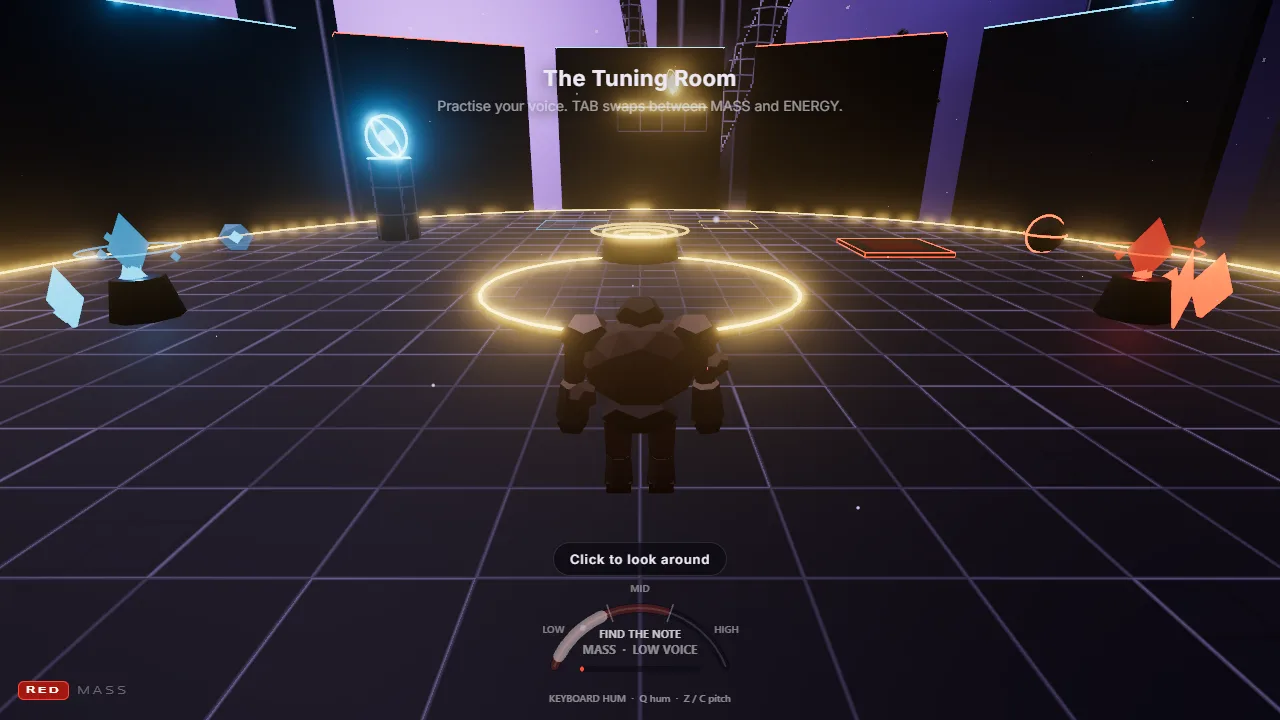
- The Tuning Room is a solo space for practising your voice before you play with someone.
Setting up your voice
The first time you play, a short calibration listens to the room's background noise, a soft and a strong hum, and the lowest and highest notes you can sing comfortably. From then on, everything is measured against your range: there are no fixed notes to hit, and you never need to be loud. You can recalibrate from the pause menu at any time, which is worth doing if you change rooms or microphones.
- Use headphones. Echo cancellation is on, but the game's music leaking from speakers into your microphone is the most common reason the game hears a voice that is not there.
- Hum, do not shout. A steady, comfortable hum is easier for the game to read than a loud one, and you will be doing it for a long time.
- Your voice stays on your device. The game works out pitch and loudness locally, a few times a second, and only those numbers are sent.
How the game hears you
Four things in your voice matter:
- Pitch: where the note sits in your range, from low through mid to high. RED is in tune in the lower part, BLUE in the upper part, and both work around the middle.
- Loudness: how strongly your voice acts, between your soft and strong calibration hums.
- Sustain: holding a note. Most effects last only while you keep sounding; when a voice drops, what depends on it fades after a moment's grace.
- Pulses: a short, sharp sound. RED's pulse yanks nearby things inwards; BLUE's blasts them outwards and upwards.
Your voice reaches things in front of you, up to about ten metres away, in the direction you are looking. Something you are already holding in your field stays held as you turn, so you can lead it around without staring at it.
RED: the low voice of mass
RED hums low to drag heavy things towards them along the ground, make things count heavier on pressure plates, anchor spinning machines so they stop, and ground live current so it is safe. RED also powers the red systems in each stage.
BLUE: the high voice of energy
BLUE sings high to lift things, to the height of the note, and to make them light. BLUE energises machines, carries a beam of current wherever they look, and dissolves barriers.
Working together
Neither voice can finish a stage alone, and most puzzles need both at once. A classic example: a monolith is too heavy for RED to drag, because the ground holds it, and too heavy for BLUE to lift. But BLUE lightening it takes the friction away, and then RED's pull wins. Everything is real physics, so if something nearly works, more voice or a better angle usually finishes it.
When both voices sound at once near the right thing, that is harmony: bridges of light appear, gravity lets go, and bosses' cores burn. Harmony forms after both of you have been sounding together for a quarter of a second, and breaks if either stops.
Talk to each other. Besides optional voice chat in a private room, F (or the middle mouse button) pings a spot, and 1 to 8 send quick calls: "Hold that note!", "Go higher!", "Go lower!", "Now!", "Together!", "Don't stop!", "Wait!" and "Over here!". If you get stuck, both players can vote to return to the last checkpoint by holding R, or from the pause menu.
The journey
There are seven regions and 21 stages:
- The Hollow: First Light, Weight and Light, The Lantern Shaft. The basics of both voices.
- The Foundry: Cold Forges, The Crucible Line, Ingot Bridge, and the first boss, The Anvil Warden.
- The Chasm: Vertigo Stair, Gravity Wells, The Long Fall. Gravity fields that weaken while they are powered.
- The Gardens: Bloom, The Thorn Ferry, The Chorus Tree.
- The Conduit: Live Wire, Lighthouse, Counterspin, and the second boss, The Resonance Guardian. Beams, mirrors and timing.
- The Fracture: Shattered Span, Leapfrog. Broken gravity.
- The Core: The Choir's Heart and the last boss, The Dissonance.
The bosses
- The Anvil Warden. Its two hammer arms take turns: each one aims at one of you (watch for the warning), slams, and sticks in the floor for a moment. While an arm is stuck, RED's hum holds it down and BLUE singing at its valve overloads it; two overloads break an arm. With both arms gone, the core opens, and only harmony close to it burns it down, while a low beam sweeps the floor and shockwaves roll out. Keep the harmony going: the core heals whenever it breaks.
- The Resonance Guardian. Three lenses orbit it. Its eye locks on to one of you and fires a slowly tracking beam: RED can ground it, BLUE can carry it, and BLUE sending it into a lens cracks the lens. The ring spins too fast to aim at unless RED anchors it from close by. Then the core spins two beams like a lighthouse: RED anchors the spin while BLUE stands in a beam and sends it back into the core.
- The Dissonance. Everything at once. First, two pylons feed it, and each overloads only while RED pins it and BLUE sings at it, so both of you work the same pylon while jumping a beam that sweeps the floor. Then three mask shards orbit it; BLUE carries its eye's beam into a shard while RED holds the mask still from close in. Finally its core sinks and spins two beams: harmony near the core burns it, BLUE sending a beam back burns it faster, and RED's hum slows the spin.
In every boss fight, being hit stuns you and cuts your voice for a moment, so dodging matters as much as singing.
Sigils, shards and rewards
Every stage has three hidden resonance shards and three sigils:
- Swift: beat the stage's target time.
- Shards: find every resonance shard.
- Flawless: no falls, no checkpoint resets and no hits.
Sigils unlock auras for each voice at 3, 9, 18 and 30, along with crests and titles. Every stage stays open, so go back for missed sigils, faster times, or to play it from the other side. Achievements, best times and cosmetics are saved for you.
Controls and playing without a microphone
- Keyboard and mouse: W A S D to move, the mouse to look, Shift to run, Space to jump, E to interact, carry or throw, Esc to pause.
- Gamepad: sticks to move and look, A to jump, X to interact, B or L3 to run, RB to ping, the d-pad for quick calls, Start to pause.
- Touch: a thumb stick to move, drag the right side to look, and buttons for jump, use and ping.
- No microphone? Hold Q to hum from the keyboard, with Z and C to lower and raise the pitch. On a gamepad, the right trigger hums and the left trigger with the right stick sets the pitch; on a touch screen, hold HUM and slide up or down.
Ready to play?
Resonance: Two Voices runs in your browser, free, with nothing to install. Play Resonance: Two Voices now, or browse the categories for something else.
More guides
- Playing online with friends
- Keepsies: a guide to mibs, marbles and the eight Rings
- Little Bubbling: a guide to brewing, selling and staying out of the cells
- Syphon's Slap Arena: how to slap harder, defend and win the Slap League
- Chaos Island: how to survive every disaster
- Camp Kindling: a guide to your first nights
- Tall Tails: a fishing guide
- Contrail Cup: planes, stages and racing tips
- Pulsar League: a beginner's guide to rocket football
- Shrap guide: weapons, maps, modes and winning gunfights
- Packfall: playing with your dog, and staying alive
- Acheron: a guide to your first escape
- Secret of Rapture: a spoiler-light guide
- Veyrfall: a tactics guide to the Broken Dominion
- Los Pantalones guide: story, gangs, money and losing the cops
- Sigilclash guide: card rules, captures, deck building and the campaign
- Drakonia guide: hatching, care, missions, battles and evolution
- Dragon Egg Traders guide: towns, prices, poachers and reaching 100,000 gold
- Greenside: a golf guide to all nine holes
- Road Riot: a guide to fighting, racing and staying out of handcuffs
- Scorch Circuit guide: weapons, the championship, upgrades and staying alive
- Pocket Grand Prix guide: drifting, turbos and faster laps
- Snowbound guide: faster runs, clean landings and every gate
- Lockdown: Undead strategy: how to survive more rounds
- Survillian guide: how to survive, level up and prestige
- Protocol: Biomass guide: survive longer in the dark
- Voidlance guide: weapons, the Prism Core and all five bosses
- Blast Grid guide: charges, power-ups, enemies and every arena hazard
- Tilt guide: three stars, every world and the level editor
- Neon Rush tips: how to run further and score higher
- SydeScroller guide: jumping, obstacles, power-ups and longer runs
- Encore guide: cues, ghosts, the Hook and how to last longer
- Lineflow guide: how to build tracks that flow
- Physics puzzle games: Cannon Crush, Gravity Breaker, Bankshot and Frog Delivery Service
- Short story games: Scales of Justice, Department of Lost Things, One Minute to Extinction and more
- Quick arcade games: Freefall, Reality Rumble, Prism Pop, Snack Attack, 60 Second Sketch and Breakout
- Blackjack basic strategy: when to hit, stand, double or split
- How to play Texas Hold'em: hands, odds and position
- 8 ball pool rules: fouls, ball in hand and how to win
- How to play pinball: rules, scoring and tips for both tables
- Air hockey rules and tips: how to score and defend
- Bowling scoring explained: strikes, spares and the 10th frame
Spotted something out of date? Games here are updated often, so tell us through the contact page and we will fix the guide.